Subject and Object Pronouns Lesson Plan: I or Me, He or Him?
- 1st Grade
- Grammar: subject and object pronouns
- 40 minutes
A pronoun is a word that takes the place of a noun, so we don’t have to keep repeating a name: “Ben kicked the ball. He kicked it far.” Most pronouns also have two forms. One is for the person or thing doing the action (I, he, she, we, they), and one is for the person or thing the action happens to, or that comes after words like to, for and with (me, him, her, us, them). It and you stay the same in both jobs.
Young native speakers often say “Me and Tom went to the park” or “Her is my friend”, and that is a normal stage of language development. English learners have extra work, because many languages don’t change a pronoun’s form at all. Children should already know that a noun names a person, place, animal or thing, and be able to find the action word in a simple sentence.
Objectives
- Explain that a pronoun takes the place of a noun.
- Replace a noun with he, she, it, we or they.
- Choose between I and me, he and him, she and her, we and us, and they and them by noticing whether the word is doing the action or receiving it.
- Use “and I” and “and me” correctly with another person’s name.
What you need
- Name cards for a few children in the class and picture cards for an animal, an object and a group (three dogs, some books)
- Pronoun cards in two colors: I, he, she, we, they on one color; me, him, her, us, them on the other; it and you on both
- A two-column chart labeled “Doing the action” and “Getting the action”
- Mini whiteboards and markers
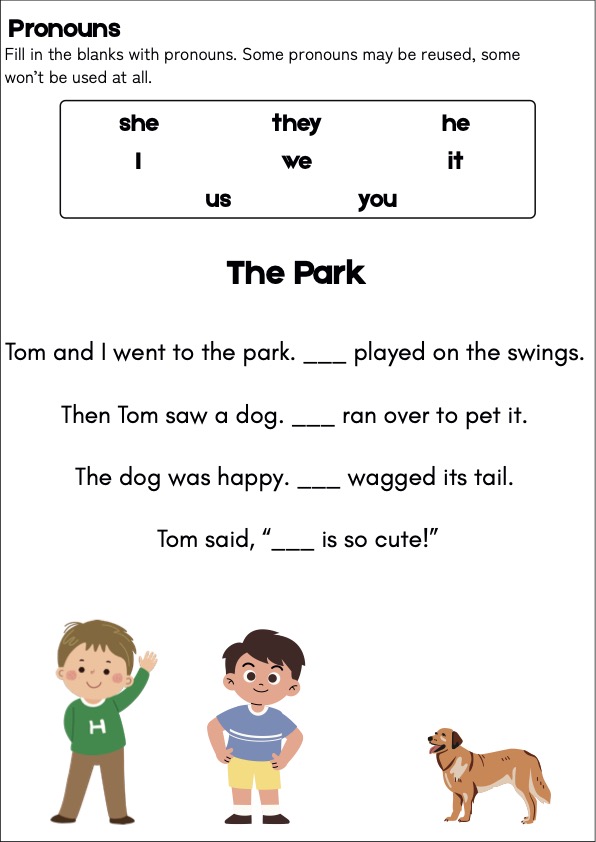
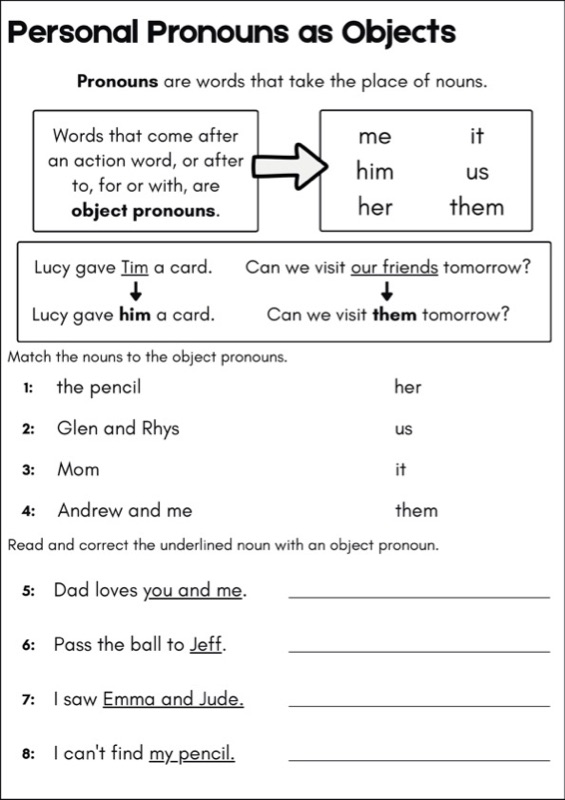
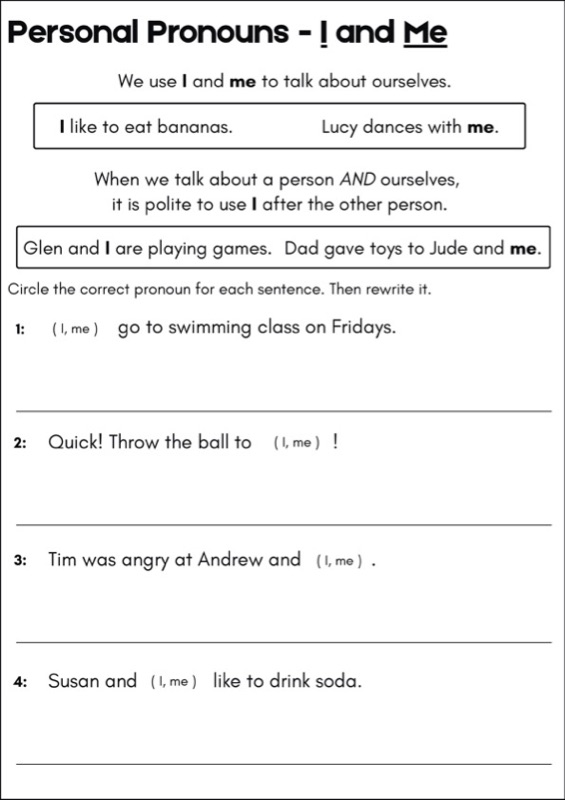
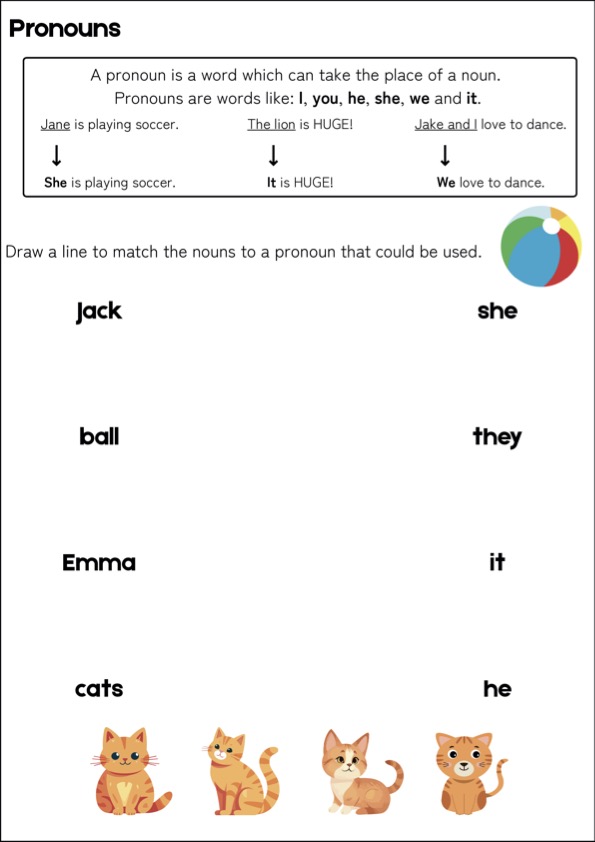
- Optional: pronoun matching worksheets, fill-in-the-blank pronoun stories, or object pronoun and I/me practice pages
Word lists
- Doing the action (subject pronouns)
- I, you, he, she, it, we, they
- Getting the action (object pronouns)
- me, you, him, her, it, us, them
- Swap sentences
- Ben kicks the ball. → He kicks it. / Rosa and I feed the fish. → We feed them. / The dog licks Grandma. → It licks her. / Mr. Lee helps Sara and Tom. → He helps them.
- Gap story: Out in the Snow
- Jada and I went outside. ___ made a snowman. Jada gave ___ a carrot for its nose. Then Max came over. ___ threw a snowball at ___! We laughed and threw snowballs back at ___. (Answers: We, me, He, us, him)
The lesson, step by step
1. Warm-up: too many names (5 min)
Tell a very short story using one child’s name in every sentence: “Kenji came to school. Kenji sat down. Kenji opened a book. Kenji smiled.” Ask the class how it sounds. Someone will say it is too much Kenji. Tell it again with “he” in place of the name after the first sentence.
Say: “He is a pronoun. A pronoun is a little word that takes the place of a noun.”
2. Swap the noun (8 min)
Hold up a name or picture card and have children call out the pronoun that could replace it. Mix the cards so there is no pattern to follow:
- one girl’s name → she
- one boy’s name → he
- the pencil → it
- three dogs → they
- “Mia and I” → we
Then point around the room instead of using cards: point to a girl, to two children, to a chair, to yourself and a child together. The “Mia and I” cards are the ones children most often get wrong, so return to them a second time.
3. Doers and getters (9 min)
Write “She hugs him.” Ask: “Who is doing the hugging? Who is getting the hug?” Explain that the pronoun changes depending on its job. Put the pairs on the chart side by side: I and me, he and him, she and her, we and us, they and them.
Act it out with two volunteers. One waves and says “I wave at her.” The other waves back and says “She waves at me.” Repeat with “We clap for them” and “They clap for us”, using two small groups.
Give children a rule of thumb to say aloud: before the action word, use the doing form. After the action word, or after to, for or with, use the getting form.
4. The I or me trick (7 min)
Write two sentences: “Tom and ___ went to the park.” and “Mom gave Tom and ___ a cookie.” Show the cover test. Cover “Tom and” with your hand and read what is left. “I went to the park” sounds right; “me went to the park” does not. “Mom gave me a cookie” sounds right; “Mom gave I a cookie” does not.
Explain that it is polite to name yourself last: “Tom and I”, not “I and Tom”. Then read four more sentences aloud and have children hold up their I or me card for each.
5. Gap story (7 min)
Display the Out in the Snow story. Pairs read it together and write the missing pronouns on their whiteboards, using the cards to help. Go through it as a class. For each gap, ask who the pronoun refers to and whether that person is doing the action or getting it. That question is the point of the activity: children have to read for meaning to choose the right word.
6. Wrap-up (4 min)
Go around the circle. Each child says one sentence about a classmate using he or she, and one about the class using we. As an exit task, children complete two sentences: “___ and Maya played tag.” and “Dad read a book to Maya and ___.”
Support and challenge
- For children still unsure what a pronoun is, teach only the doing forms (he, she, it, we, they) in this lesson and add the getting forms on another day.
- Confident writers can rewrite a short paragraph that repeats the same names, deciding where a pronoun helps and where the name is needed so the reader knows who is who.
Tips for ESL and EFL classes
- Japanese marks who does what with particles such as が and を, and the word for he or she doesn’t change form. Pronouns are also often left out completely. The idea that “he” becomes “him” is new, so the color-coded cards and the two-column chart do a lot of the teaching here.
- In spoken Mandarin, he and she are both pronounced “tā”, so Chinese-speaking children often mix up he and she even when they understand the grammar. Put a simple picture of a boy and a girl on those two cards and gently recast mistakes in conversation.
How to check learning
- Can the child replace a noun with the right pronoun in a mixed set of people, animals, things and groups?
- Do they choose the getting form after an action word, as in “Lucy saw him”?
- Can they use the cover test to choose between I and me when another name is in the sentence?
What to teach next
Next, teach possessive pronouns (my, his, their, mine, yours, theirs), which answer the question “whose?”. Keep the two-column chart on the wall. When children write their weekend news, ask them to circle each pronoun and check who it points to; this catches unclear “he” and “they” as well as wrong forms.
Printables for this lesson
Optional. These Ribbit Pond worksheets match the lesson if you’d rather not make your own.