Possessive Pronouns Lesson Plan: Whose Is It? From Tim’s Hat to His Hat
- 1st Grade
- Grammar: possessive nouns and pronouns
- 40 minutes
Possessive words answer the question “Whose is it?” The first tool children meet is an apostrophe and s on a name: Tim’s hat, Mom’s car. Possessive pronouns do the same job without repeating the name. One set comes before a noun (my, your, his, her, its, our, their), as in “his hat”. The other set stands on its own, usually at the end of a sentence (mine, yours, his, hers, ours, theirs), as in “The hat is his.”
The two sets cause most of the mistakes. Children say “That’s my” or write “her’s”, and once they have learned that an apostrophe shows belonging, they put one in its and yours too. Choosing between his, her and their is also a thinking step, because the pronoun matches the owner, not the thing owned: a girl’s dad is “her dad”. Children should already know the subject pronouns (I, he, she, we, they) and read simple sentences with names.
Objectives
- Add ’s to a name to show who owns something.
- Replace a possessive name with my, your, his, her, its, our or their.
- Choose his, her or their by looking at the owner, not the object.
- Use mine, yours, hers, ours and theirs at the end of a sentence, without an apostrophe.
What you need
- A bag of objects borrowed from children for the lesson (a hat, a water bottle, a pencil case, a book)
- Pronoun cards in two colors: my, your, his, her, its, our, their on one color; mine, yours, his, hers, ours, theirs on the other
- Mini whiteboards and markers
- The gap story below, written on chart paper
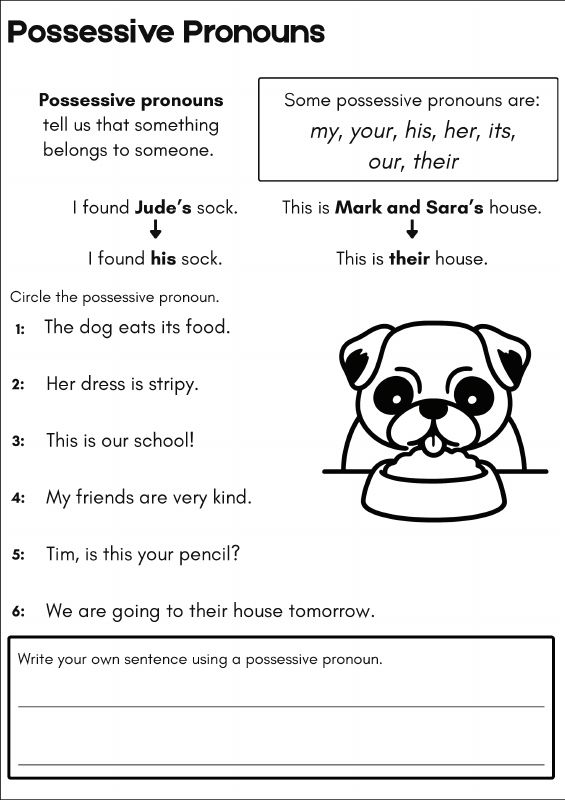
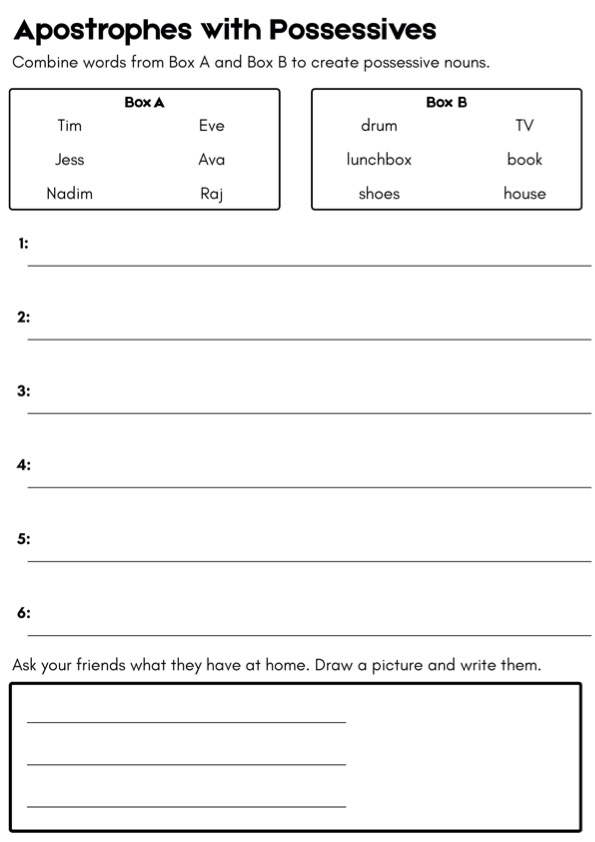
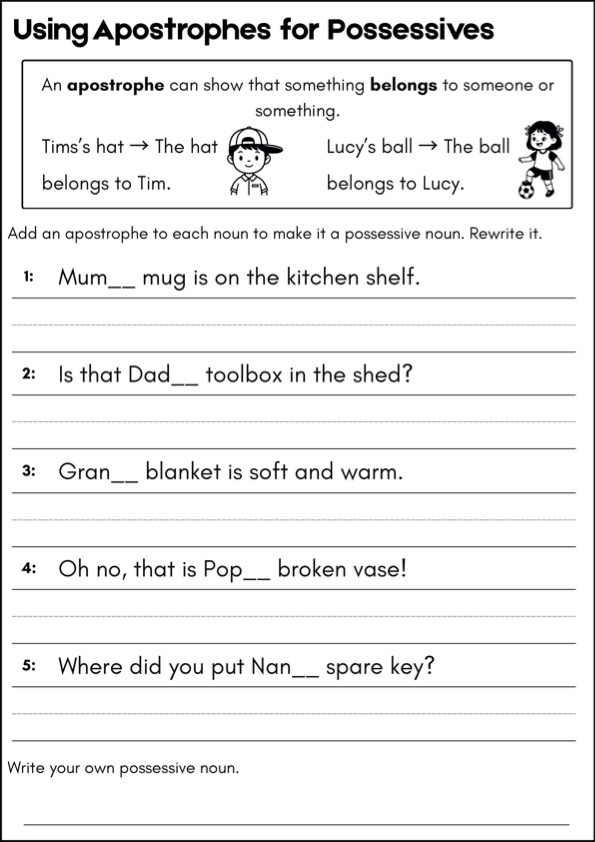
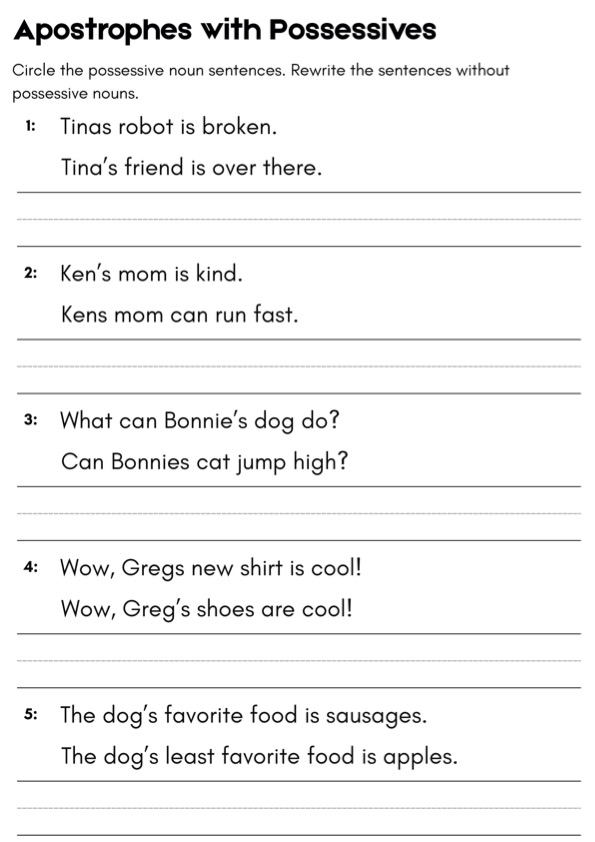
- Optional: possessive pronoun rewriting worksheets and possessive noun apostrophe practice pages
Word lists
- Before a noun
- my, your, his, her, its, our, their
- On their own
- mine, yours, his, hers, ours, theirs
- Swap sentences
- Mia’s backpack is red. → Her backpack is red. / This is Leo’s lunch. → This is his lunch. / The dog wagged the dog’s tail. → The dog wagged its tail. / The bikes are Ana and Raj’s. → The bikes are theirs. / The green cup is my cup. → The green cup is mine.
- Gap story: The Lost and Found Box
- Ms. Park held up a blue hat. “Whose hat is this?” Omar shook his head. “It’s not ___. My hat is green.” Lily looked closely. “I think it is Ben’s. That is ___ hat!” Ben ran over. “Yes, it’s ___! Thank you.” Then Ms. Park held up two lunch boxes. The twins, Ella and Rose, jumped up. “Those are ___!” (Answers: mine, his, mine, ours)
The lesson, step by step
1. Warm-up: whose is it? (6 min)
Take one borrowed object out of the bag and ask, “Whose water bottle is this?” The owner answers, “It’s Kenji’s.” Write “Kenji’s water bottle” on the board and circle the apostrophe and s. Say: “This little mark and the s tell us who owns it.”
Do two more, then have each child write one on a whiteboard: a classmate’s name, ’s, and something that person has today. Check that the apostrophe sits before the s.
2. From names to his, her and their (9 min)
Under “Kenji’s water bottle”, write “his water bottle”. Ask: “Who owns it? A boy. So we say his.” Then work through a few more, with children holding up the right card:
- Sara’s hat → her hat
- Ana and Raj’s books → their books
- the cat’s bowl → its bowl
- Sara’s dad → her dad
Stop on the last one. Many children will say “his dad” because a dad is a man. Ask again: “Whose dad? Sara’s. So it’s her dad.” Give them the rule to say aloud: look at the owner, not the thing.
3. My, your and our (6 min)
Hold up your own mug: “This is my mug.” Hand it to a child: “This is your mug.” Sweep your arm around the room: “This is our classroom.” Pairs then take turns pointing at things and saying a sentence with my, your or our. Listen for children who use “me” in place of “my” (“That’s me pencil”) and recast it in your reply.
4. Words that stand alone (9 min)
Write “This is my book.” and under it “This book is mine.” Point out that mine has no noun after it. Lay out the second set of cards next to the first so the pairs line up: my and mine, your and yours, his and his, her and hers, our and ours, their and theirs. His stays the same.
Write “her’s” and “your’s” on the board and cross them out with a big X. None of these words ever takes an apostrophe, and neither does its.
Then mix the borrowed objects on a table for a game. One child picks one up and asks a classmate, “Is this yours?” The classmate answers “Yes, it’s mine,” or “No, it’s his” or “No, it’s hers,” pointing to the owner.
5. Gap story (6 min)
Read The Lost and Found Box together. Pairs write the missing words on their whiteboards. Go through each gap and ask two questions: Who owns it? Is there a noun right after the gap? If a noun follows, the word comes from the first set (his hat). If the sentence ends, it comes from the second set (it’s mine).
6. Exit task (4 min)
Children complete three lines on a slip of paper: “This is Leo’s cap. This is ___ cap.” “The cap is ___.” Then one sentence of their own using mine or yours. Sort the slips afterward into children who have both sets and children who need the second set again.
Support and challenge
- For children still unsure of the apostrophe, spend the lesson on the first two steps only, with names, ’s, his, her and their. Teach mine and yours on another day.
- Confident writers can fix a short paragraph that repeats the owner’s name (“Nina put on Nina’s coat and Nina’s scarf”) and decide where a pronoun reads better.
- Stronger readers can try plural owners: “The toys are the children’s” becomes “The toys are theirs.”
Tips for ESL and EFL classes
- Japanese uses one form, の, for both my and mine (watashi no hon, “my book”; kore wa watashi no, “this is mine”), and Mandarin does the same with 的. So “The book is my” is a direct translation, not carelessness. The two card colors and the question “Is there a noun after it?” do most of the teaching here.
- In spoken Mandarin, he and she are both pronounced tā, so his and her get mixed up even when a child understands the idea. Put a small boy or girl picture on those cards and recast gently: “Yes, it’s her bag.”
- Spanish su can mean his, her, its, their or your, so Spanish-speaking children also need to practice matching the pronoun to the owner.
How to check learning
- Can the child write a possessive name with the apostrophe before the s?
- Do they choose his, her or their by the owner, as in “Sara’s dad” → “her dad”?
- Do they use mine, yours, hers, ours and theirs at the end of a sentence, without an apostrophe?
What to teach next
Keep a lost and found box going for a week. Whoever returns an item has to ask “Is this yours?” and the owner answers in a full sentence. After that, move on to indefinite pronouns such as someone, everyone and nobody, which answer a different question: not whose, but who at all.
Printables for this lesson
Optional. These Ribbit Pond worksheets match the lesson if you’d rather not make your own.