5 W’s Lesson Plan: Who, What, Where, When and Why for 1st–2nd Grade
- 1st–2nd Grade
- Grammar and reading: question words
- 45 minutes
Who, what, where, when and why are the question words children use to find the key details in a story, and they are also a simple map for building a sentence of their own. Each one asks for a different kind of answer. Who wants a person or an animal. What wants a thing or an action. Where wants a place, when wants a time, and why wants a reason, usually starting with because.
Children often know the words but mix up what they ask for: ask “When did she go?” and someone will answer “To the park.” Asking a question is harder again. English puts the question word first and adds a helper verb such as do, did or is, so learners say “Where you live?” or “What he is doing?”. Children should be able to read simple sentences and know that a question ends with a question mark.
Objectives
- Explain what kind of answer each of the five W words asks for.
- Sort phrases by the question they answer.
- Build a sentence that answers who, what, where and when, then add a reason with because.
- Answer 5 W questions about a short story in full sentences, and turn an answer back into a question.
What you need
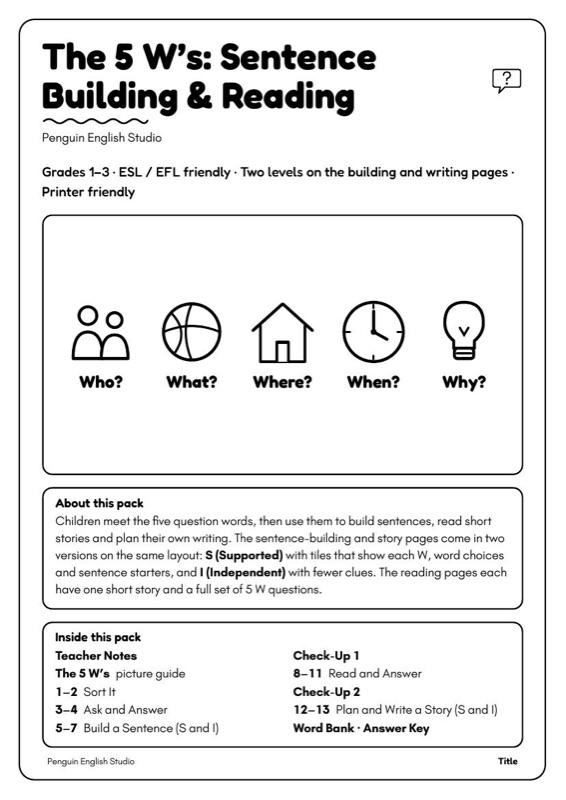
- Five large cards: Who, What, Where, When and Why, each with a picture cue (a face, a box, a map pin, a clock, a lightbulb)
- The phrase strips below, cut up, one set per group
- The story below, on chart paper or printed
- Mini whiteboards and markers
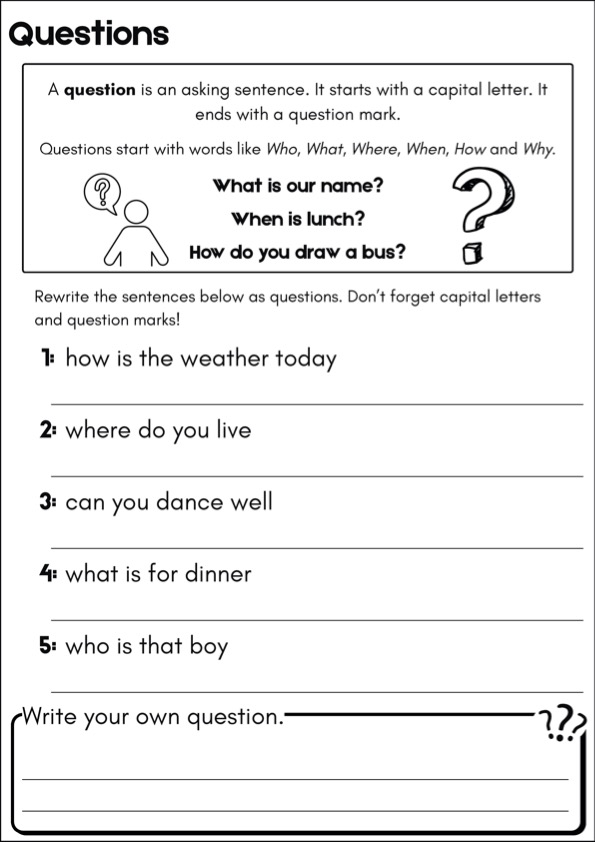
- Optional: 5 W’s sorting and sentence-building worksheets, and asking-sentence rewrite pages
Word lists
- What each W asks for
- Who → a person or animal / What → a thing or an action / Where → a place / When → a time / Why → a reason (because…)
- Phrase strips to sort
- my grandma, a tiny puppy, the bus driver, ate a sandwich, kicked the ball, at the pool, under the bed, in the garden, after lunch, on Saturday, every morning, because it was raining, because she was hungry, because he lost his hat
- Human sentence
- The puppy (who) / hid (what) / under the bed (where) / after the storm (when) / because it was scared (why) → The puppy hid under the bed after the storm because it was scared.
- Story: The Lost Kite
- On Saturday, Nora and her dad went to the park. Nora had a new red kite. The wind was strong, and the string slipped out of her hand. The kite flew up into a tall tree. Nora was sad because she could not reach it. Then a park worker came with a long pole and pulled the kite down. Nora said thank you and flew her kite again, holding the string tight.
- Story questions
- Who went to the park? / What did Nora have? / Where did the kite go? / When did they go to the park? / Why was Nora sad?
The lesson, step by step
1. Warm-up: real questions (5 min)
Ask the class four quick questions with true answers: “Who is sitting next to you? Where do you eat lunch? When do you go to bed? Why do we wear coats?” After each answer, hold up the matching card and ask, “What kind of answer did that question want? A person? A place?”
2. What does each W want? (7 min)
Put the five cards on the board with their picture cues and say the pairs together: who, a person; where, a place; and so on. Then call out answers and have children point to or name the card that fits:
- “at the zoo” → where
- “last night” → when
- “because I was cold” → why
- “my brother” → who
- “a big sandwich” → what
Listen especially for where and when. They are the pair most often confused, so give a few extra examples of each.
3. Sort the phrases (8 min)
Groups sort the phrase strips into five columns under the W cards. Check by reading one column aloud: “Where: at the pool, under the bed, in the garden. Do they all tell us a place?” Talk through the strips groups disagree on. “Every morning” is a time even though it has no clock number in it, and “ate a sandwich” answers what, because what can ask about an action as well as a thing.
4. Build a sentence one W at a time (9 min)
Make a human sentence. Three children hold the who, what and where strips (The puppy / hid / under the bed), and the class tells them where to stand until the sentence reads correctly. Add a fourth child with “after the storm”, then a fifth with “because it was scared”, reading the whole sentence aloud after each addition.
Point out the usual English order: who, what, where, when, then why at the end. Then swap one child for a new strip (“My grandma” in place of “The puppy”) and read the new sentence. Silly results are fine, and they show that each slot takes only one kind of answer.
5. Read and answer (11 min)
Read The Lost Kite aloud, then have partners read it to each other. Ask the five story questions. Children answer in full sentences (“They went to the park on Saturday.”) and come up to underline the words in the story that gave the answer.
Then turn it around. Give an answer, such as “Into a tall tree,” and ask children to make the question on their whiteboards. Model the first one: Where + did + the kite + go? Show that the W word goes first and did comes next.
6. Wrap-up: ask a partner (5 min)
Each child writes one question for a partner about their weekend, using any W word, a capital letter and a question mark. Partners swap, answer in a full sentence, and say which W their answer was.
Support and challenge
- For beginning readers, teach who, what and where in this lesson and add when and why on another day.
- Confident writers can write a five-sentence story of their own, then give it to a partner, who writes one question for each W.
- If children answer why with a single word (“Rain”), give them the frame “because it was ___” and have them say the whole answer.
Tips for ESL and EFL classes
- In Japanese, Korean and Mandarin, the question word usually stays where the answer would be and the verb doesn’t move, so “Where you live?” is a natural first try. Put the helper verb on its own colored card and slide it in after the W word: Where + do + you + live?
- Spanish and Portuguese don’t use a helper like do in questions either, so children from those backgrounds benefit from the same colored card.
How to check learning
- Can the child match an answer to the right question word, especially telling where from when?
- Can they answer a 5 W question about the story in a full sentence?
- Can they write a question with the W word first, a helper verb, a capital letter and a question mark?
What to teach next
Use the five cards at morning meeting: one child shares a piece of news, and the class asks one question for each W. Later, have children plan their own short stories with one line per W before they start writing, so every story has a character, a place, a time and a reason for what happens.
Printables for this lesson
Optional. These Ribbit Pond worksheets match the lesson if you’d rather not make your own.