Describe a Monster Lesson Plan: It Has, It Doesn’t Have for K–2 ESL
- Kindergarten–2nd Grade
- Speaking: describing with has and doesn’t have
- 40 minutes
“It has two eyes and a long tail” is one of the first describing patterns English learners need, and young native speakers use it too when they explain a drawing. A lot is packed into it: has (not have) after it, an article or a number before every noun, a plural -s when there is more than one, and a negative, doesn’t have, that goes back to plain have. A monster is a good subject for practicing it, because children invent the parts and every part is a noun they can count.
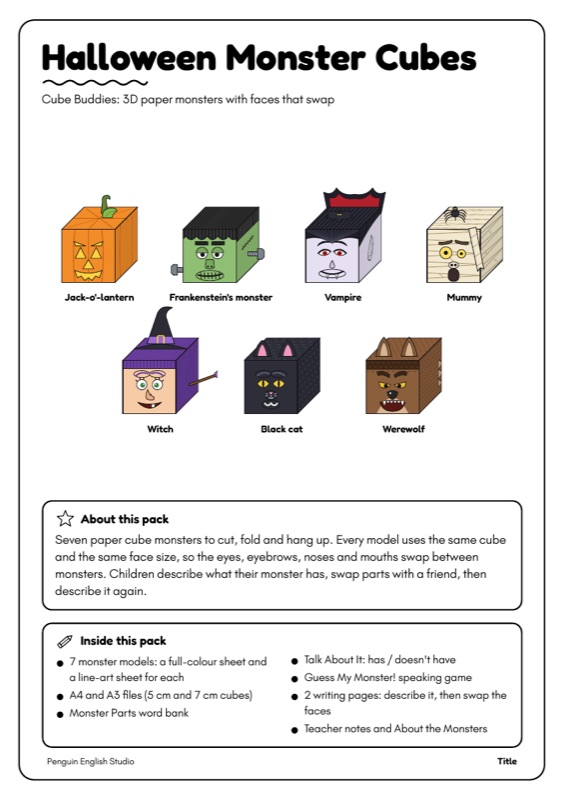
The usual mistakes are “It have”, “It has tail”, “It has two eye” and “It doesn’t has”. This lesson keeps the sentence frame fixed and changes the parts, so children hear and say the pattern many times in one session. They should know basic face words (eyes, nose, mouth, ears) and numbers to five. The same lesson works for Halloween monsters in October or, in a culture unit, for characters such as Japanese yokai or Day of the Dead sugar skulls.
Objectives
- Describe a monster with “It has…”, using a or a number and a plural -s where needed.
- Say what a monster doesn’t have with “It doesn’t have…”.
- Ask and answer “Does it have…? Yes, it does. / No, it doesn’t.”
- Write two or three describing sentences.
What you need
- A square of paper for each child, about 6 inches across, to draw a monster head on
- Sticky notes for face parts, so parts can be peeled off and swapped
- Crayons or markers
- A monster you have made yourself, for modeling
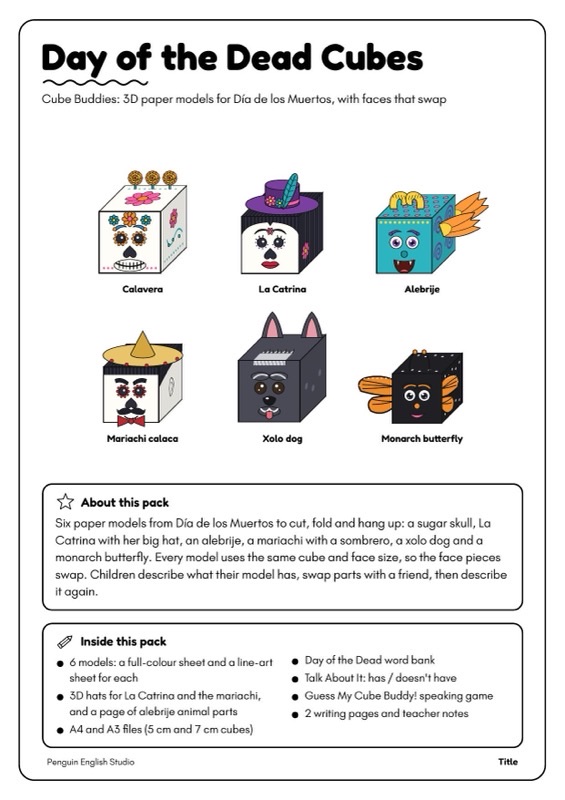
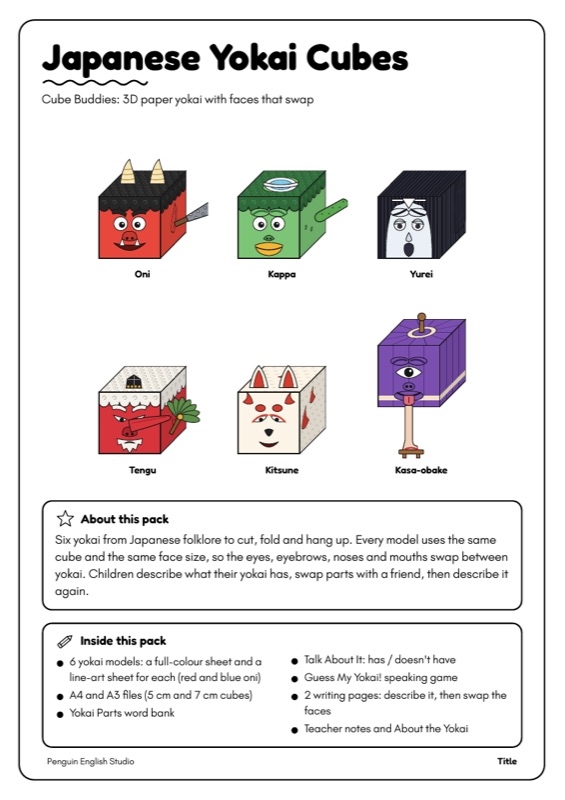
- Optional: paper cube monster crafts with swappable face pieces, plus a parts word bank and has/doesn’t have grid
Word lists
- Monster parts
- a nose, a mouth, a tail, a hat, one eye, two eyes, three eyes, two ears, horns, fangs, wings, spikes, whiskers, spots
- Describing words
- big, small, long, short, round, pointy, furry, spiky, scary, funny
- Sentence frames
- It has ___. / It has two ___. / It doesn’t have ___. / Does it have ___? Yes, it does. / No, it doesn’t.
- Model description: Mr. Bump
- This is my monster, Mr. Bump. It is green and round. It has three eyes and a big mouth. It has two small horns. It doesn’t have a nose. It doesn’t have arms, but it has a long, spiky tail.
The lesson, step by step
1. Warm-up: what does it have? (5 min)
Draw a monster on the board one part at a time and let children call out what you add: “Eye!” Answer with the full sentence each time: “Yes, it has one eye.” Then point to your own face: “I have two eyes. It has one eye.” Do this twice more so children hear I have and it has side by side.
2. One or more than one? (7 min)
Say the monster parts together with a gesture for each. Then sort them on the board into two columns, “one” and “more than one”: a tail, a nose and one eye in the first; two ears, horns and fangs in the second.
Tap the board on the final s of each plural as you say it. Children repeat, and you listen for the s. A child who says “two horn” is not missing the idea of plurals; they are not hearing or saying the ending yet, and the tapping helps.
3. Make a monster (10 min)
Children draw a monster head on their paper square and put the face parts on sticky notes: eyes, a mouth, horns, ears, whatever they like. The parts need to come off later, so they should not draw them straight onto the head.
Move around as they work and ask each child questions: “Does it have a nose? How many eyes does it have?” Accept one-word answers, then give back the full sentence for them to repeat.
4. Has and doesn’t have (6 min)
Show your own monster and read the Mr. Bump description. Write two lines on the board: “It has a mouth.” and “It doesn’t have a nose.” Underline has and have. Explain that after doesn’t, we go back to have.
Children tell a partner two things their monster has and one thing it doesn’t have. Listen for “doesn’t has” and recast it.
5. Swap and guess (8 min)
Partners swap two sticky-note parts and describe their new faces: “Now it has fangs. It doesn’t have horns.” Swapping is what makes children use the negative, because a part they had is suddenly gone.
Then put five children’s monsters at the front. One child secretly chooses one, and the class asks yes/no questions until they find it: “Does it have a tail?” “No, it doesn’t.” Ask for the full short answer, not just yes or no.
6. Write it (4 min)
Children write two or three sentences under their monster using the frames: two with has and one with doesn’t have. Kindergartners can copy one frame and fill in the part, or tell you a sentence for you to write.
Support and challenge
- For kindergarten or very new learners, practice only “It has…” with one and two, and leave the negative for another day.
- Stronger speakers can add describing words (“It has two long ears”) and join ideas with but: “It has wings, but it doesn’t have a tail.”
- Children who find drawing slow can choose from a tray of parts you have drawn on sticky notes ahead of time.
Tips for ESL and EFL classes
- Japanese and Korean have no articles and usually don’t mark plurals, so “It has tail” and “two eye” are expected. Write a or two on every part in the word list and keep tapping the final s.
- If you use Japanese yokai, children from Japan may already know characters such as the oni, with its horns and club, or the kappa, with a dish of water on its head. Let them be the class experts and describe one first.
- If you use Day of the Dead characters, explain first that the day, on November 1 and 2, is a family celebration that remembers loved ones who have died. Sugar skulls are decorations, not scary monsters, so keep that set separate from Halloween talk.
How to check learning
- Does the child use has after it, with a or a number before each part?
- Can they say what the monster doesn’t have without saying “doesn’t has”?
- Can they answer a yes/no question with “Yes, it does” or “No, it doesn’t”?
What to teach next
Hang the monsters up and use them as a warm-up for the next week: point at one and ask a child to describe it, or describe one yourself and have the class find it. Later, move the same pattern to people (“She has long hair. He doesn’t have glasses.”) and to animals in science, where it does real work: a spider has eight legs, and it doesn’t have wings.
Printables for this lesson
Optional. These Ribbit Pond worksheets match the lesson if you’d rather not make your own.