Telling Time to the Hour and Half Hour Lesson Plan: Short Hand First
- 1st Grade
- Math: telling time to the hour and half hour
- 45 minutes
An analog clock asks a lot of a six-year-old. There are two hands on one face, and the same numbers mean different things depending on which hand is pointing at them. Most early mistakes come from mixing up the hands, or from reading the long hand first. Half-hour times add a second trap: at 4:30 the short hand sits between the 4 and the 5, and many children read it as five thirty because the 5 is the number it is heading toward.
This lesson teaches one habit that fixes both problems: read the short hand first and say the hour, then look at the long hand. Children should be able to count to 12 and read the numbers 1 to 12. It helps if they already know what “half” means from folding paper or sharing food.
Objectives
- Name the hour hand and the minute hand and say what each one tells us.
- Read and show o’clock times on an analog clock and write them as digital times, such as 3:00.
- Read and show half-hour times, saying them as “three thirty” and “half past three”.
- Read a short sentence about a daily activity and show its time on a clock.
What you need
- A large teaching clock with hands that move (a paper plate clock with a split pin works)
- A small clock for each child: a paper plate or card circle with the numbers 1 to 12, two card hands of clearly different lengths and a split pin
- Mini whiteboards and markers
- A paper circle to fold in half
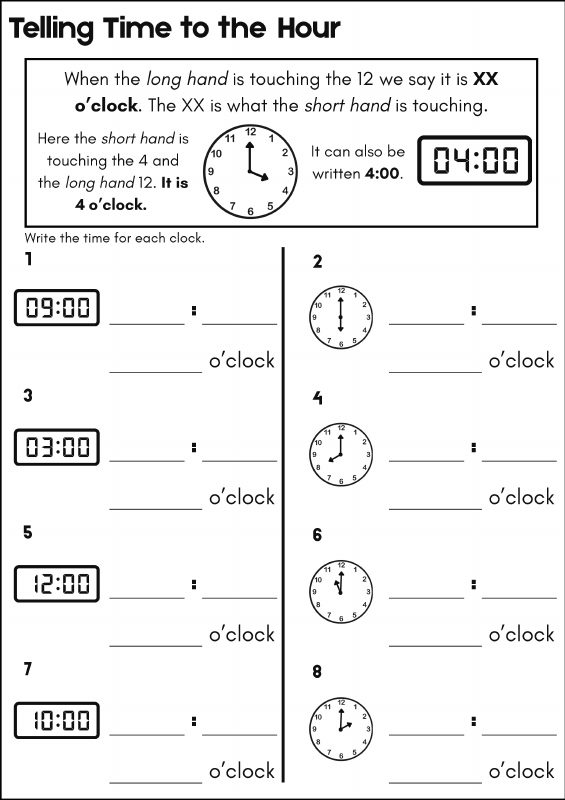
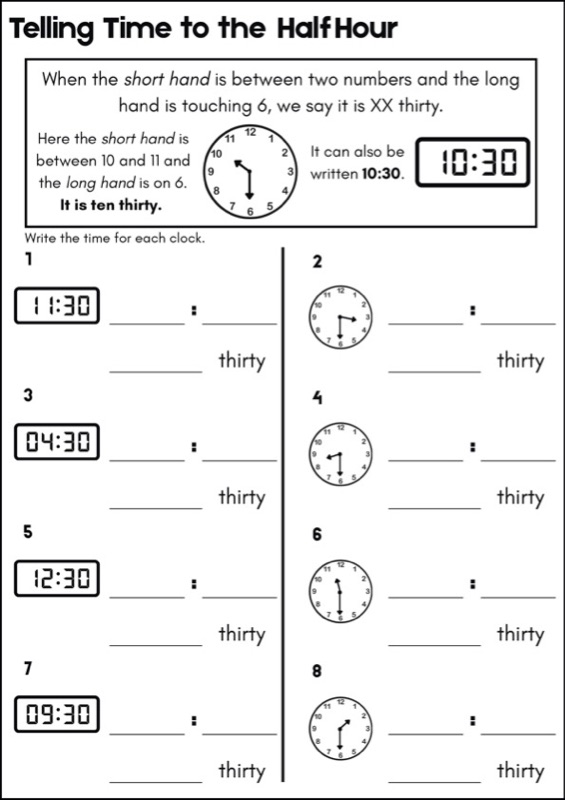
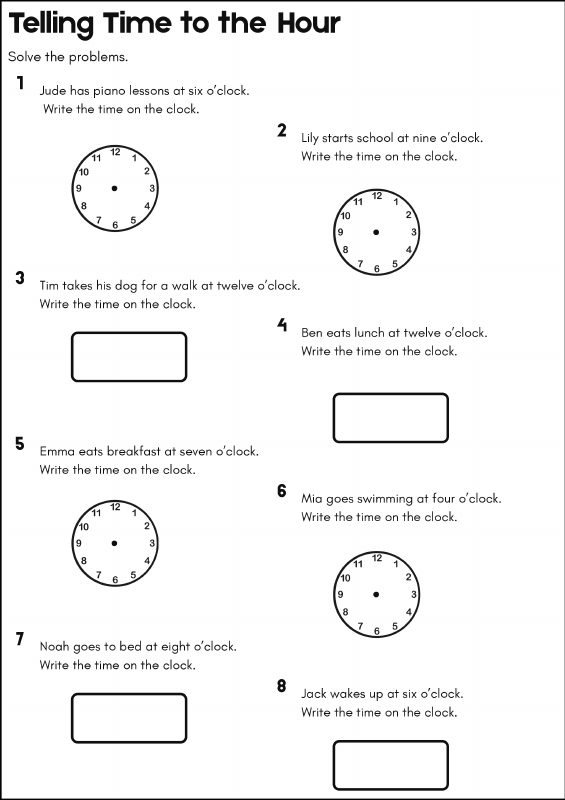
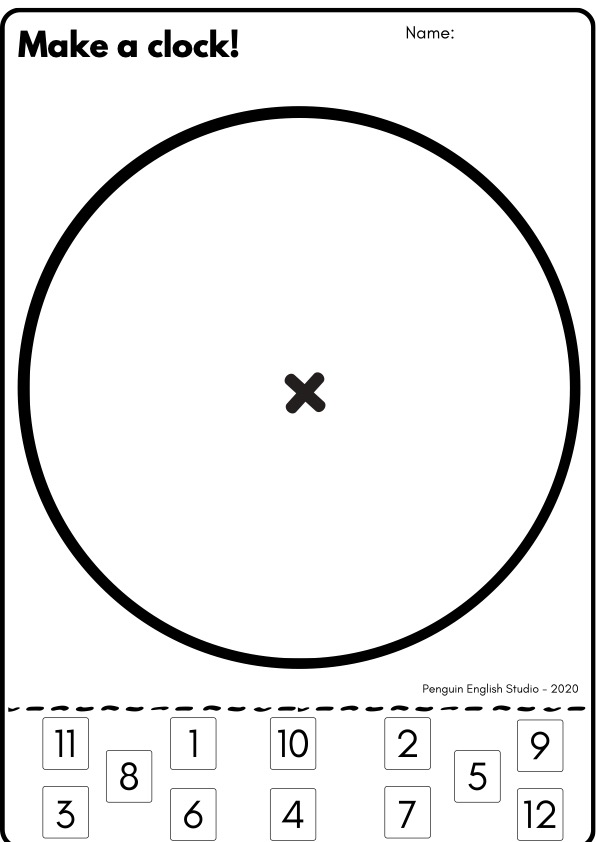
- Optional: telling time worksheets for o’clock and half-hour times, time word problems, or a self-checking digital clock activity
Word lists
- Clock words
- hour hand (the short hand), minute hand (the long hand), o’clock, thirty, half past, analog clock, digital clock
- O’clock times
- 1:00, 3:00, 6:00, 7:00, 9:00, 12:00
- Half-hour times
- 2:30, 4:30, 5:30, 8:30, 10:30, 12:30
- Time stories
- Mia eats breakfast at seven o’clock. / Leo walks the dog at four thirty. / The bus comes at half past eight. / Grandpa takes a nap at two o’clock. / We have art at ten thirty. / Sam goes to bed at half past seven.
The lesson, step by step
1. Warm-up: when do we do it? (5 min)
Ask a few children what they do before school, after school and before bed, and put three answers in order on the board. Then ask: “How does your family know when it’s time to leave for school?” Someone will say the clock. Today they learn to read it themselves.
2. Meet the two hands (8 min)
Hold up the teaching clock. Point to the short hand: “This is the hour hand. It moves slowly and tells us the hour.” Point to the long hand: “This is the minute hand. It goes all the way around the clock in one hour.” A memory trick that helps: “hour” is a short word and goes with the short hand; “minute” is a longer word and goes with the long hand.
Set the clock to 3:00. Say: “When the long hand points straight up to the 12, it is something o’clock. The short hand tells us what. The short hand points to 3, so it is three o’clock.” Write 3:00 underneath and explain that the two zeros mean zero minutes past the hour.
Show 6:00, 9:00, 1:00 and 12:00. Each time, children touch their nose when they have found the short hand, then say the time together.
3. Show me o’clock (7 min)
Hand out the small clocks. Call out an o’clock time and have children set their clocks and hold them up. Scan the room for two things: the long hand on the 12, and the short hand pointing right at the hour number.
Then pairs take turns. One child says a time, the other shows it, and they swap after each one. Listen for children who move the long hand to the hour number. Ask them to show you which hand is the hour hand before they try again.
4. Half past (10 min)
Fold the paper circle in half and show the two halves. Set the teaching clock to 3:00 and move the long hand slowly around to the 6, nudging the short hand forward a little as you go. Ask: “How far around has the long hand gone?” (Halfway.) “So half an hour has passed. Where is the short hand now?”
Children will see it is between the 3 and the 4. Say: “It has left the 3 but hasn’t reached the 4 yet. It is still in the three hour. We say three thirty, or half past three.” Write 3:30.
Practice 5:30, 8:30 and 10:30, and save 12:30 for last, because the short hand sits between the 12 and the 1, which confuses many children. Give them one rule to say aloud:
- When the short hand is between two numbers, say the number it has just passed.
- The long hand pointing down at the 6 means thirty.
5. Time stories (10 min)
Read the time stories one at a time. Children show each time on their clock, then write the digital time on their whiteboard. Mix o’clock and half-hour times so they have to listen for “thirty” or “half past” and can’t simply copy the last answer.
Listen for children who hear “half past eight” and write 8:50 or 9:30. Ask them to set the clock first and then read the digital time from it.
6. Wrap-up (5 min)
Show four times, two on the teaching clock and two written as digital times, and have the class say each one aloud. As an exit task, children draw the hands for 6:30 on a blank clock face and write the time in words underneath.
Support and challenge
- For children who keep confusing the hands, start with an hour-hand-only clock. Take the long hand off and ask whether the short hand is right on the 3, a little past it, or halfway to the 4. Add the minute hand back once they can do this.
- Confident children can write a schedule for their own Saturday with five times on it and draw a clock beside each one, or try quarter past and quarter to.
Tips for ESL and EFL classes
- Japanese says the hour first and then “han” for half, so 3:30 is “san-ji han”. English “three thirty” uses the same order, while “half past three” flips it. Teach “three thirty” first and introduce “half past three” as a second way to say the same time.
- Many Japanese learners add a vowel after a final consonant, so “o’clock” can come out as “o-clock-u”. Clap it as two beats, “o-CLOCK”, and remind children that the l in “half” is silent.
How to check learning
- Can the child point to the hour hand and say what it tells us?
- Can they show an o’clock time and a half-hour time on their clock, including 12:30?
- When they hear a time in words, can they write the matching digital time?
What to teach next
In the next lesson, mix o’clock and half-hour times in story problems and connect them to the class timetable; a paper clock by the door set to lunchtime gives children a reason to check it every day. When they can read half past without slipping to the next hour, move on to quarter past, quarter to and counting minutes by fives.
Printables for this lesson
Optional. These Ribbit Pond worksheets match the lesson if you’d rather not make your own.