Solar System Reading Comprehension Lesson Plan for 1st and 2nd Grade
- 1st–2nd Grade
- Reading: nonfiction comprehension
- 40 minutes
Space is one of the most reliable topics for getting young children reading nonfiction. They want to know which planet is hottest and whether you could stand on Jupiter. This lesson teaches a core nonfiction skill, finding a fact in the text to answer a question, using short passages about the planets.
Use your own short passage (an example is below), a children’s nonfiction book, or printed planet passages.
Objectives
- Learn and use key space vocabulary: Sun, planet, star, orbit, hot, cold, big, small.
- Answer questions by finding and underlining the sentence that gives the answer.
- Write a short fact report about one planet.
What you need
- A short passage about one planet for each group
- Pictures of the Sun and the eight planets
- Highlighters
- Fact cards for the sort activity
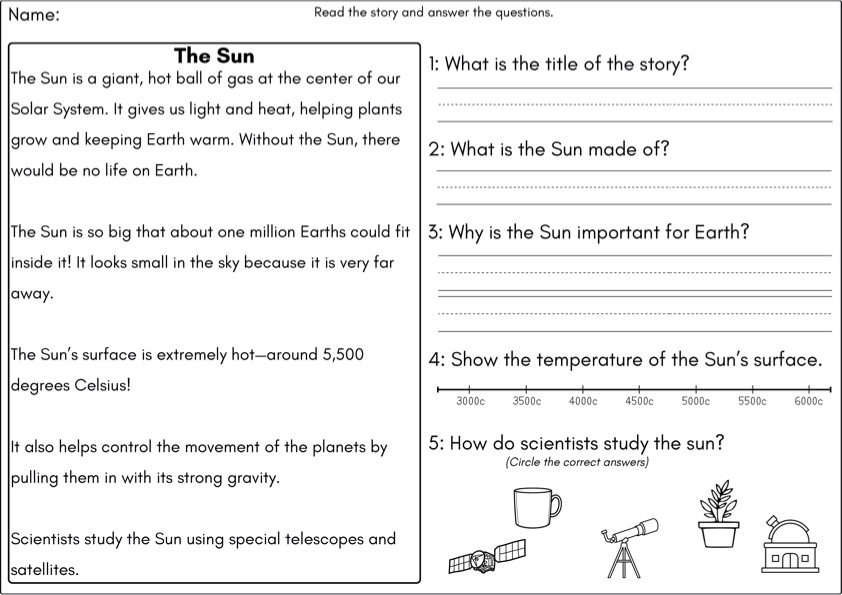
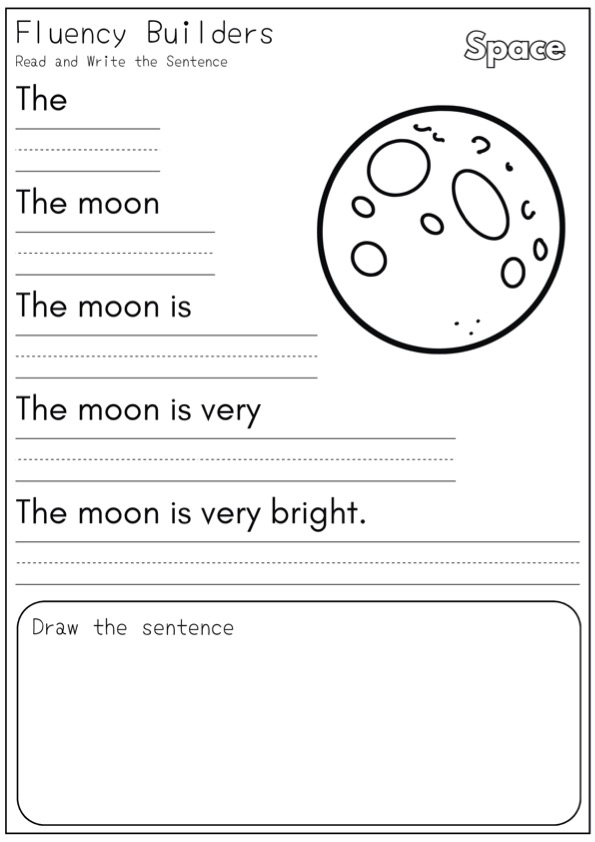
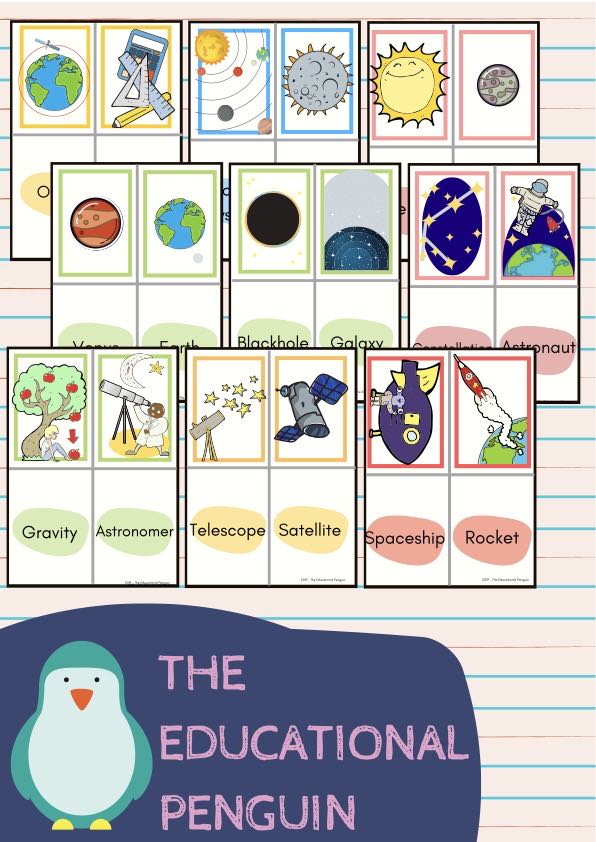
- Optional: printed solar system passages, sentence pyramids and space flash cards
Word lists
- Vocabulary
- Sun, star, planet, orbit, hot, cold, big, small, ring, storm, spacecraft
- Example passage (Mars)
- Mars is the fourth planet from the Sun. It is called the red planet because its dust is red. Mars is smaller than Earth. It is very cold on Mars. Scientists have sent robots called rovers to drive on Mars and study its rocks.
The lesson, step by step
1. Warm-up: what do we know? (5 min)
Show a picture of the solar system. Ask children to name anything they can see. Write their ideas on the board in two columns: “We know” and “We want to know”. Questions like “Is the Sun a planet?” are perfect, and you can come back to them at the end.
2. Vocabulary (6 min)
Teach the key words with pictures and actions. For “orbit”, have one child be the Sun and another walk in a circle around them. For “planet” versus “star”, explain that the Sun is a star: it makes its own light, while planets don’t.
3. Read and find (10 min)
Read the Mars passage aloud while children follow along. Then read it together. Ask one question at a time and have children find and underline the sentence that answers it:
- “Why is Mars called the red planet?”
- “Is Mars bigger or smaller than Earth?”
- “What are rovers?”
Ask them to point to the answer before anyone says it. The habit you’re building is “go back to the text”, not “guess from what you remember”.
4. Planet fact sort (8 min)
Give groups a set of fact cards and picture cards for four or five planets: “I have a big red spot. It is a storm.” (Jupiter) “I have rings made of ice and rock.” (Saturn) “I am the closest planet to the Sun.” (Mercury) “I spin on my side.” (Uranus) “People live on me.” (Earth). Groups match each fact to a planet and read their matches aloud.
5. Mini report (8 min)
Each child chooses a planet and writes three facts about it, using a frame: “___ is a planet. It is ___. It has ___.” They draw the planet beside their facts. Children who finish early can add a question they still have.
6. Wrap-up (3 min)
Return to the “We want to know” list from the warm-up. Answer any questions the class can now answer, and save the rest for another day or a library visit.
Support and challenge
- For early readers, use passages of three or four sentences and read them aloud first, then focus on finding answers.
- For strong readers, ask comparison questions that need two passages: “Which is colder, Mars or Neptune?”
Tips for ESL and EFL classes
- Planet names differ between languages. In Japanese, for example, the names are built from elements (Mars is 火星, “fire star”). Teach the English names with pictures and say them often.
- Comparatives like “bigger” and “smaller” appear constantly in space texts. A quick practice with classroom objects (“The book is bigger than the pencil”) helps before reading.
How to check learning
- Can the child underline the sentence that answers a question?
- Can they use at least four of the vocabulary words correctly?
- Does their mini report contain three facts that are true for their planet?
What to teach next
Read one planet passage each day for a week and add to a class solar system wall. Finish the unit with a planet fluency activity or a game where children describe a planet and the class guesses it.
Printables for this lesson
Optional. These Ribbit Pond worksheets match the lesson if you’d rather not make your own.