Be Verbs Lesson Plan: Am, Is, Are Today and Was, Were Yesterday
- 1st Grade
- Grammar: be verbs in the present and past
- 40 minutes
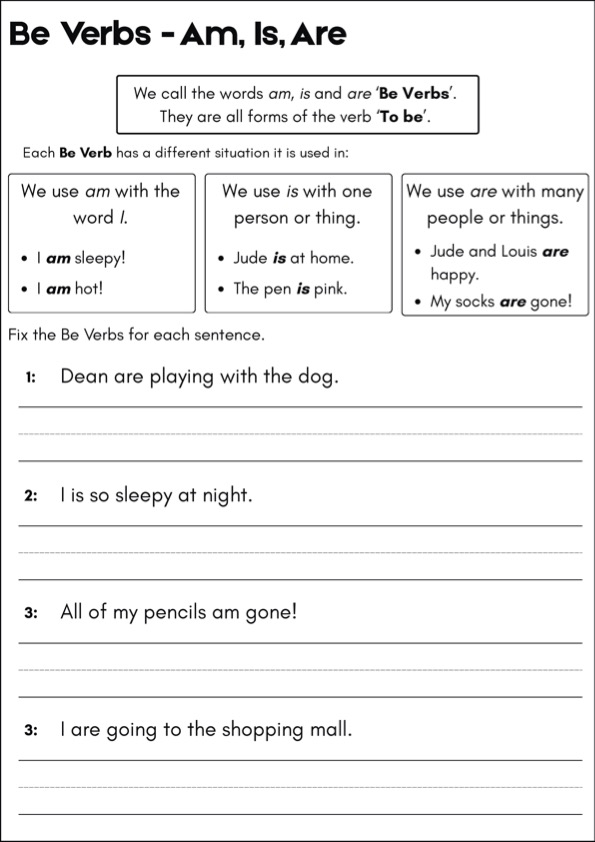
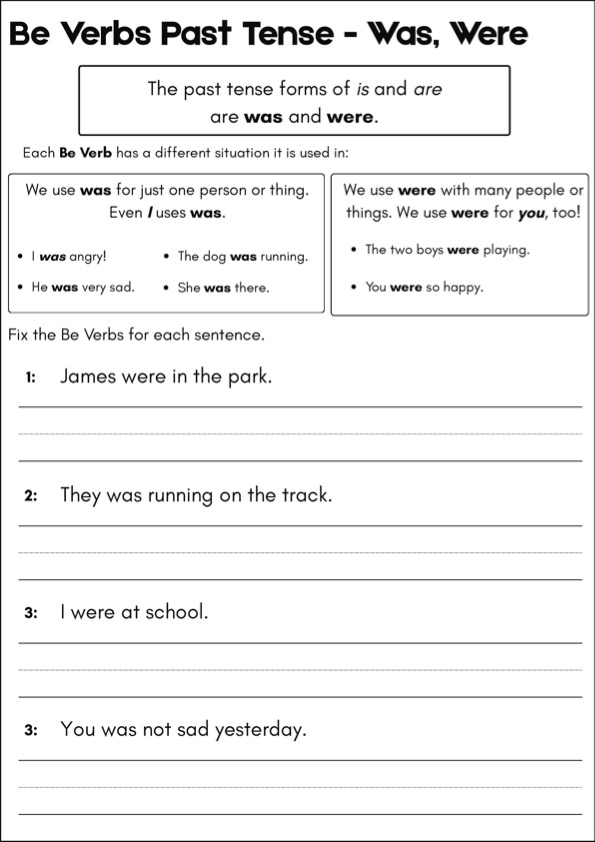
The verb be is the most common verb in English, and it is also the most irregular. In the present it has three forms: am goes with I, is goes with one person or thing (he, she, it, the cat, Mia), and are goes with more than one (we, they, the dogs) and with you. In the past there are only two: was for I and for one person or thing, were for more than one and for you.
Children hear these words all day, but they say “The dogs is barking” or “We was late” because they have not noticed that the subject decides the form. The two hardest spots are I and you. I takes am but was, and you takes are and were even when it means one person, so a simple “one or many” rule doesn’t quite cover them. Children should be able to read short sentences and know the subject pronouns I, you, he, she, it, we and they.
Objectives
- Choose am, is or are by looking at the subject of the sentence.
- Choose was or were for the same subjects when the sentence is about the past.
- Remember the two special cases: I am, I was; you are, you were.
- Find and fix a sentence that uses the wrong be verb.
What you need
- Three large cards for the board: am, is, are
- Two more cards in a different color: was, were
- A few classroom objects (one pencil, a handful of pencils, one book, a stack of books)
- Mini whiteboards and markers
- The sentences below, written on chart paper
- Optional: am, is, are choice-and-rewrite worksheets and was/were practice pages
Word lists
- Present
- I am / he is, she is, it is, Mia is, the cat is / we are, they are, the cats are / you are
- Past
- I was / he was, she was, it was, Mia was, the cat was / we were, they were, the cats were / you were
- Today sentences
- I ___ six years old. / The bus ___ yellow. / The children ___ in the gym. / You ___ my friend. / Ken and Ana ___ at the door. / It ___ cold outside. (Answers: am, is, are, are, are, is)
- Yesterday sentences
- I ___ tired after the trip. / The puppies ___ asleep. / My sister ___ at home. / You ___ very kind. / We ___ on the bus. / The soup ___ too hot. (Answers: was, were, was, were, were, was)
- Fix it
- The dogs is hungry. / I is ready. / We was at the zoo. / You was right. / The cake were yummy. / My friends was late.
The lesson, step by step
1. Warm-up: point and say (5 min)
Point to yourself: “I am a teacher.” Point to one child: “Leo is in the front row.” Sweep your hand over a table group: “They are at Table 2.” Then point to the class: “You are first graders.” Do three or four of each and let children say them with you.
Ask: “I said am, is and are. What made me change the word?” Someone usually notices that it depends on who you are talking about.
2. One or more than one (8 min)
Put the am, is and are cards on the board. Hold up one pencil: “The pencil is long.” Hold up a handful: “The pencils are long.” Write both sentences and circle the s on pencils and the verb. Repeat with the books.
Then sort the subjects from the word list under the three cards with the class. Put I alone under am, the singular subjects under is, and the plural ones under are. Leave you until last and place it under are. Tell the class: “You is never right, even when I’m talking to just one of you.”
Listen for “I is” and “The children is”. Children is a tricky one because it has no s, so ask, “Is it one child or more than one?”
3. Today sentences (7 min)
Read the today sentences one at a time. Children write only the missing word on their whiteboards and hold it up. For each one, ask a child to point to the subject first and then say the verb. Finding the subject first is the habit you want to build.
4. Move it to yesterday (9 min)
Say: “Yesterday I was a teacher too.” Put the was and were cards under is and are. Show that am and is both turn into was, and are turns into were. Move the subjects across: I was, he was, the cat was; we were, they were, you were.
Then take three of the today sentences and say them about yesterday: “The bus was yellow.” “The children were in the gym.” Children change the cards with you. Read the yesterday sentences and do them on whiteboards the same way as before. Expect “I were” from some children, because they have just learned I has its own form. Point to the board: I was.
5. Fix the sentences (6 min)
Show the fix-it sentences. Pairs read each one aloud and decide if it sounds right. Have them say the fixed sentence before they write it. Ask a pair to explain one: “Dogs is more than one, so it should be are.”
6. Exit task (5 min)
Children write two sentences about themselves: one with am about today and one with was about yesterday or last year (“I am seven. I was six last year.”). Then they fill in one blank: “My friends ___ at the park yesterday.” Collect the slips and note who still writes “I is” or “they was”.
Support and challenge
- For children who are not ready for both tenses, teach am, is and are in this lesson and leave was and were for the next day, with the same sentences moved to yesterday.
- Stronger writers can write a short diary entry about last weekend in four sentences, each using was or were with a different subject.
- Children who are unsure of singular and plural can hold up one finger or a whole hand before choosing, so the choice is physical before it is written.
Tips for ESL and EFL classes
- Japanese uses one form, da or desu, for every subject, and Mandarin uses shì for every subject, so a learner has no reason to think the verb should change for I, he or they. Keep the subject sorting chart on the wall and point to it whenever you recast.
- Mandarin and Korean often leave out a verb like be before a describing word, so “He happy” and “The soup hot” are common. Ask, “Where is the be word?” and let the child add it.
- Mandarin doesn’t change verbs for the past, and it shows time with words such as yesterday. Underline the time words in the yesterday sentences so children connect them with was and were.
How to check learning
- Does the child find the subject before choosing am, is or are?
- Can they move a sentence to the past with was or were?
- Do they use I am, I was, you are and you were correctly?
What to teach next
Keep the board cards up and use them at morning meeting. One child says how they feel today (“I am sleepy”), and the class reports it back (“Dan is sleepy”). On Mondays, ask about the weekend so children use was and were with real news. When be verbs are steady, move on to action verbs that add s for one person, as in “Sam plays” and “They play”, which follows the same one-or-many idea.
Printables for this lesson
Optional. These Ribbit Pond worksheets match the lesson if you’d rather not make your own.