Combining Sentences Lesson Plan: Join Two Sentences with And
- 1st Grade
- Grammar and writing: combining sentences with and
- 40 minutes
Young writers often produce a list of short sentences that repeat themselves: “I went to the park. Mom went to the park. I played on the swings. I played in the sand.” Combining sentences with and is the first tool they get to fix this. There are two moves at this level. If two sentences tell the same thing about two people, join the people: “Mom and I went to the park.” If two sentences tell two things about the same person, join the actions: “I played on the swings and in the sand.”
The hard part is knowing when not to join. “We went to the park. It started raining.” are about different subjects, and a child who has just learned to combine will glue them together anyway. A second trap is the verb. “Sam plays soccer. Jane plays soccer.” becomes “Sam and Jane play soccer”, so the s comes off, which children often miss. They should be able to read simple sentences and find who a sentence is about.
Objectives
- Join two sentences with the same action by putting the two names together with and.
- Join two sentences about the same person by putting the two actions together with and.
- Decide whether a pair of sentences can be combined, and explain why or why not.
- Notice that a verb such as plays changes to play when the subject becomes two people.
What you need
- Sentence strips for the pairs below, with each sentence on its own strip
- A large card with the word and on it
- Scissors and tape, or a pocket chart
- The friendly letter below, on chart paper
- Mini whiteboards and markers
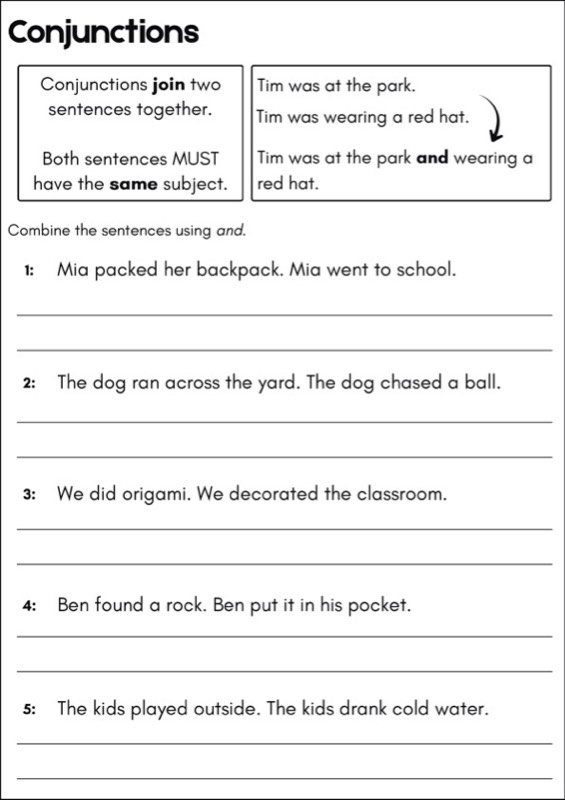
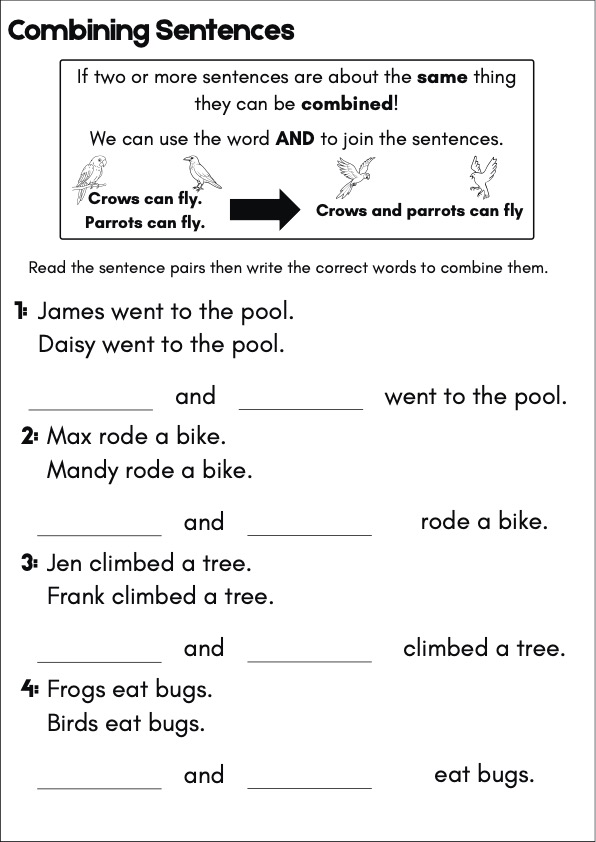
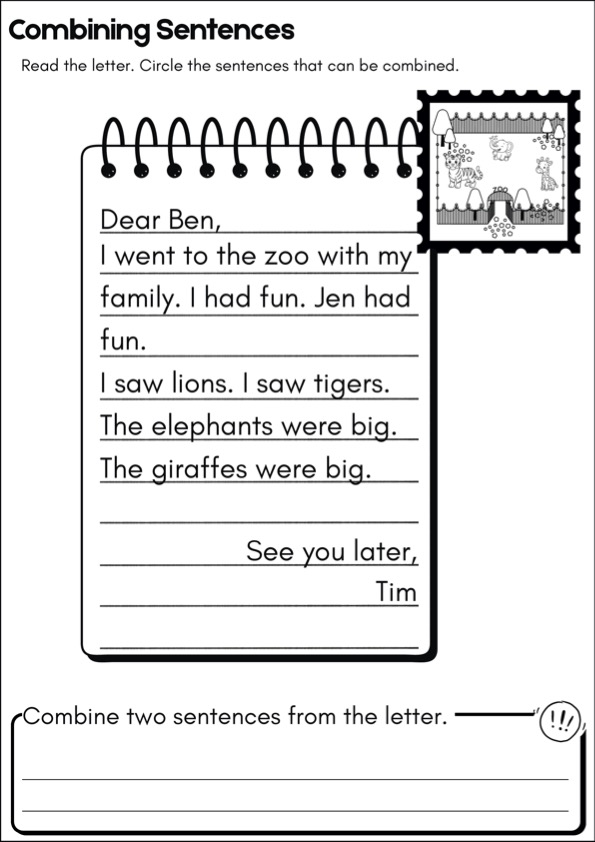
- Optional: combining sentences worksheets with guided frames, sentence groups and friendly letters to edit
Word lists
- Join the names
- Ducks can swim. Frogs can swim. → Ducks and frogs can swim. / Ella likes pizza. Max likes pizza. → Ella and Max like pizza. / The cat is asleep. The dog is asleep. → The cat and the dog are asleep.
- Join the actions
- Ben ate his lunch. Ben drank his milk. → Ben ate his lunch and drank his milk. / The bird sang. The bird flew away. → The bird sang and flew away. / Kim washed her hands. She dried them. → Kim washed her hands and dried them.
- Join or not?
- Leo found a shell. Leo put it in his bucket. (join) / I read a book. My brother played a game. (don’t join) / The bus stopped. The bus opened its doors. (join) / We ate dinner. The phone rang. (don’t join) / Nina has a kite. Omar has a kite. (join)
- Letter to edit
- Dear Grandpa, Today our class went to the farm. I saw a cow. Ruby saw a cow. We fed the goats. We petted the goats. The farmer gave us apples. Then it was time to go home. Love, Sofia
The lesson, step by step
1. Warm-up: say it once (5 min)
Read this aloud slowly, in a flat voice: “Jack has a dog. Mia has a dog. Jack walks his dog. Jack feeds his dog.” Ask the class how it sounded. Children will tell you it repeats. Ask: “How could I say the first two sentences in one go?” Take their answers and write one on the board: “Jack and Mia have a dog.”
2. Join the names (8 min)
Tape up the strips “Ducks can swim.” and “Frogs can swim.” Ask what is the same in both (can swim) and what is different (ducks, frogs). Cut the repeated part off the second strip, tape the and card between the names, and read the new sentence together.
Do the other two pairs in the join-the-names list. On the Ella and Max pair, stop and ask: “Is it ‘Ella and Max likes pizza’?” Let children hear that it sounds wrong. Two people take like, not likes. On the cat and dog pair, is changes to are for the same reason.
3. Join the actions (8 min)
Now tape up “Ben ate his lunch.” and “Ben drank his milk.” Ask what is the same this time. It is the person, Ben. Cut Ben off the second strip, put and in the middle, and read: “Ben ate his lunch and drank his milk.”
Do the bird pair, then the Kim pair. The Kim pair uses she in the second sentence. Ask, “Who is she?” Once children agree she is Kim, the sentences are about the same person and can be joined. Children write the combined Kim sentence on their whiteboards.
4. Join or not? (8 min)
Read each pair in the join-or-not list. Children show a thumbs up if the pair can be joined and a thumbs down if it can’t. For every thumbs up, a child says the joined sentence aloud. For every thumbs down, ask why: “I read a book. My brother played a game.” has two different people doing two different things, so nothing repeats.
Give the class one more question to think about: “We ate dinner. The phone rang.” How could we change it so it can be joined? One answer is to make both sentences about us: “We ate dinner and talked about our day.”
5. Fix the letter (7 min)
Read Sofia’s letter together. Partners find the two pairs that can be joined and rewrite them as one sentence each: “Ruby and I saw a cow.” and “We fed the goats and petted them.” Point out that the letter still keeps some short sentences. Not everything has to be joined, and a letter where every sentence has and in it is hard to read too.
6. Exit task (4 min)
Children write two short sentences about themselves and a friend that share an action (“I like tag. Aya likes tag.”) and then join them. Check whether they dropped the s on likes.
Support and challenge
- For children who find it hard to write the joined sentence, give a frame with blanks: “___ and ___ can swim.” Take the frame away once they can say the joined sentence without help.
- Confident writers can work with groups of three sentences, where only two can be joined, such as “Sam plays soccer. Jane plays soccer. They won the game!”
- Have early finishers reread a piece of their own writing and find one pair of sentences to join.
Tips for ESL and EFL classes
- In Japanese, to joins nouns (“Sam to Jane”), but two actions are linked with a verb ending, not a separate word. Mandarin hé also joins nouns and is not usually used between two actions. Children may join names with and easily but leave actions as two sentences. Model the join-the-actions strips more than once.
- Many learners don’t yet hear the s in likes or plays. When you read a joined sentence with two people, say the verb a little louder (“Ella and Max like pizza”) and contrast it with “Ella likes pizza.”
How to check learning
- Can the child join two sentences that share an action by putting the names together with and?
- Can they join two sentences about the same person, including when the second one uses he or she?
- Can they say why a pair with different subjects should stay as two sentences?
What to teach next
Use the two moves in writing time for a week. When children share their journals, ask the class to listen for two sentences that could be one. Later, introduce but for two ideas that don’t match (“I like apples, but I don’t like pears.”) and so for a cause and its result, using the same strip-cutting routine.
Printables for this lesson
Optional. These Ribbit Pond worksheets match the lesson if you’d rather not make your own.