Commas in a List Lesson Plan: Pack a Bag, Then Punctuate It
- 1st Grade
- Punctuation: commas in a list
- 40 minutes
When a sentence lists three or more things, commas keep the items apart so the reader knows where one ends and the next begins: “I packed a towel, a hat, sunscreen, and a snack.” The word and goes before the last item. Without commas, a list can be hard to follow, and sometimes it even changes the meaning. “I like pancakes bacon and eggs” could be read as two things or three.
First graders tend to make one of three mistakes. Some leave the commas out. Some put a comma in every sentence that has and in it, including “I like cats and dogs”, which has only two items. Others write and between every item (“milk and eggs and bread”), which is how many children talk. This plan uses a comma before the final and, as many US classrooms do. Some schools leave that comma out, so follow your school’s style and keep it the same all year. Children should be able to write a simple sentence with a capital letter and a period.
Objectives
- Explain that commas separate three or more items in a list.
- Write a list sentence with commas between the items and and before the last one.
- Tell the difference between a list of three or more and a pair joined by and, which needs no comma.
- Add missing commas to a short piece of writing.
What you need
- A bag and four or five real items to pack (a hat, a water bottle, a book, an apple, a scarf)
- Large comma cards and an and card for a human sentence
- The word banks and postcard below, on chart paper
- Mini whiteboards and markers
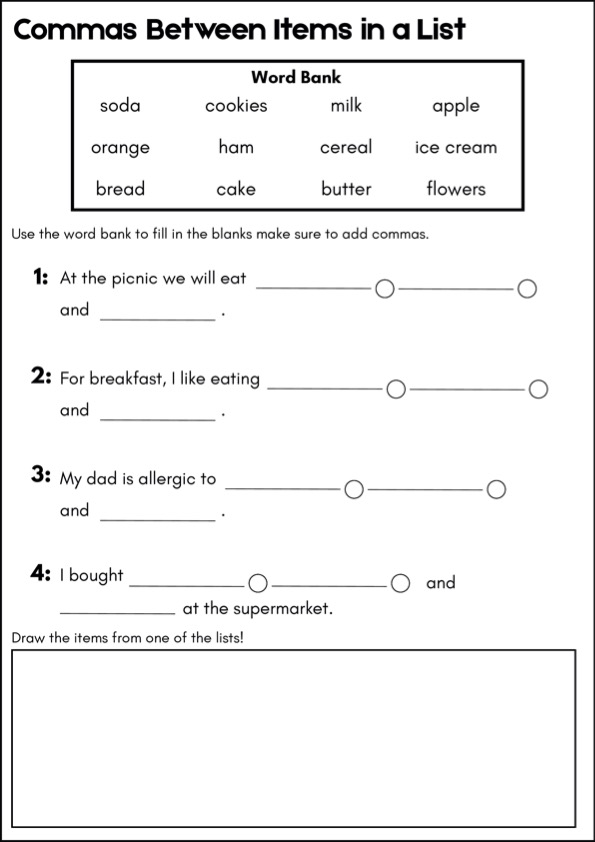
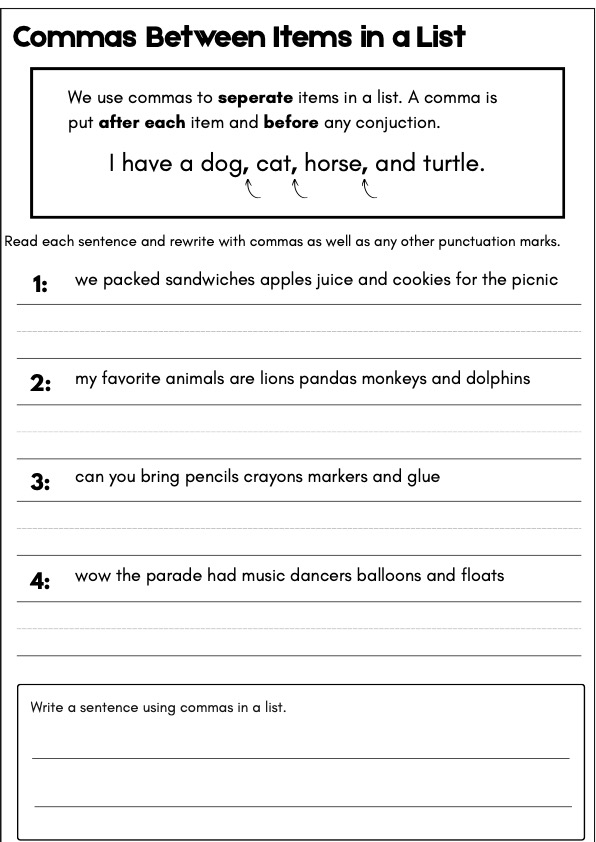
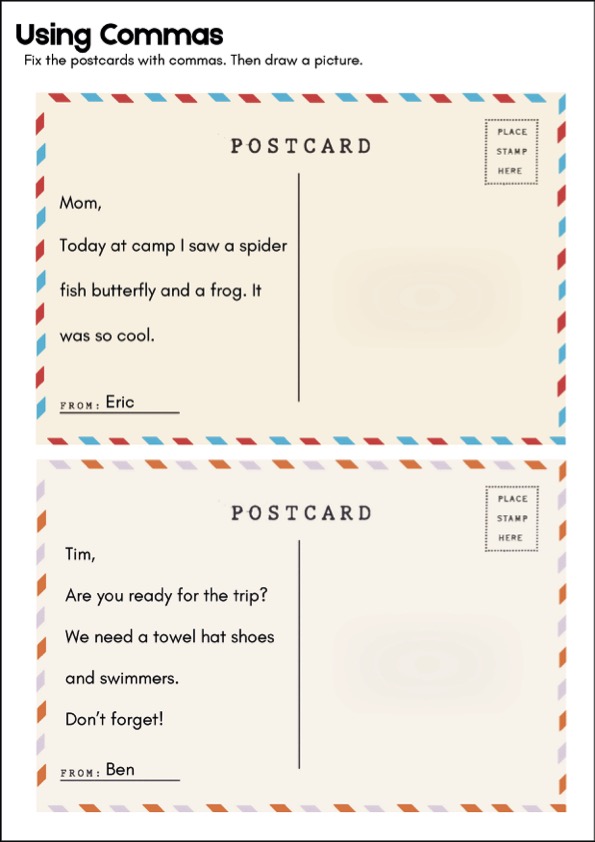
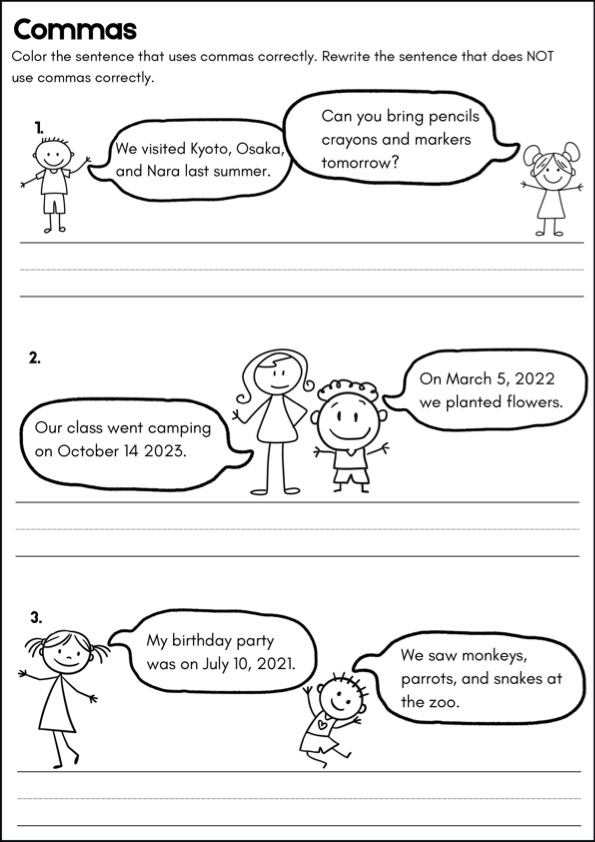
- Optional: comma fill-in pages with word banks, rewrite-and-punctuate pages, postcard editing pages, and find-the-error comma practice
Word lists
- Picnic bank
- sandwiches, grapes, juice, cookies, a blanket, napkins, cheese, carrots
- School bag bank
- pencils, a ruler, glue, crayons, a notebook, scissors, an eraser, a lunch box
- List frames
- For the picnic, we need ___, ___, and ___. / In my school bag, I have ___, ___, and ___. / At the pond, I saw ___, ___, ___, and ___.
- Comma or no comma?
- I have a cat and a dog. (no comma: two things) / We saw lions, zebras, and hippos. (list of three) / My mom and dad came to the show. (no comma) / Bring a pencil, a ruler, and glue. (list of three) / I like red, blue, green, and yellow. (list of four)
- Postcard to fix
- Dear Max, We are at the beach! Today I saw crabs seagulls and a big boat. We ate sandwiches grapes and ice cream. I found two shells and a feather. See you soon, Hana (Commas go after crabs, seagulls, sandwiches and grapes. The shells and the feather are only two things.)
The lesson, step by step
1. Warm-up: pack the bag (5 min)
Pack the bag in front of the class, saying each item: “I’m going to the park. I’m packing a hat, a water bottle, a book, and an apple.” Pause a little after each item. Ask a child to pack it again while the class counts the items on their fingers.
2. What the comma does (7 min)
Write the sentence on the board with no commas: “I packed a hat a water bottle a book and an apple.” Read it without pauses so it runs together. Ask where the little pauses were when you said it. Children point, and you add a comma at each one. Read it again with pauses.
Make it a human sentence. Four children each hold one item, and two more hold the comma cards and stand between the items. A last child holds the and card before the final item. The class reads the sentence aloud and says “comma” at each comma.
Show the pattern on the board: item, comma, item, comma, item, comma, and, item. Then point out that there is no comma after the last item, only a period.
3. Build a list (8 min)
Put up the picnic and school bag banks. Children copy one frame onto their whiteboards and fill it in with three items from a bank. Before they write, have them draw a small circle where each comma will go, then write the commas into the circles. Check that the and is before the last item and that each item makes sense in the sentence.
Ask two or three children to read their list aloud with pauses. Then try the pond frame, which needs four items, so children see that the pattern keeps going: each extra item gets another comma.
4. Comma or no comma? (6 min)
Read the comma-or-no-comma sentences one at a time, without showing the commas. Children hold up one finger if the sentence has two things and a whole hand if it is a list of three or more. Then show the sentence and count the commas together. Come back to “My mom and dad came to the show.” Two people joined by and need no comma, however long the names are.
5. Fix the postcard (8 min)
Read Hana’s postcard together. Partners copy the two list sentences onto their whiteboards and add the commas. Then discuss the third sentence: two shells and a feather is only two things, so it stays as it is. Listen to how partners count. Some will count “two shells” as two items; remind them that the shells are one thing on the list.
6. Exit task (6 min)
Children write one sentence with a list of three of their favorite foods and one sentence about two friends joined with and. Collect them and sort into three piles: commas correct, commas missing, and commas in the two-item sentence. The last pile needs the comma-or-no-comma step again.
Support and challenge
- For children still learning to write a sentence, give the frame with the comma circles already drawn and the and already written, so they only add three words.
- Confident writers can write a list sentence that is also a question (“Can you bring paper, glue, and tape?”) or that starts with a word like Wow, which needs its own comma.
- Children who write and between every item can say their list aloud first, swapping each extra and for a clap, then write a comma where they clapped.
Tips for ESL and EFL classes
- Japanese uses a small mark, 、, between items in a list, and Chinese uses a similar list mark, 、, called dùnhào. Children who have learned to write in Japanese or Chinese may draw that mark or make their commas point the wrong way. Show the English comma on a lined page so they see it sits on the line and curves down.
- Many languages, including Spanish and French, don’t put a comma before and in a list. Older siblings or parents may tell children it is wrong. Explain that both styles exist and that this class uses one style.
How to check learning
- Can the child write a list of three or more items with commas and and before the last item?
- Do they leave out the comma when only two things are joined by and?
- Can they find and add the missing commas in a short postcard or letter?
What to teach next
Once lists are steady, teach the other comma first graders meet: the comma in a date, between the day and the year, as in “October 27, 2026.” Give children mixed sentences, some with lists and some with dates, and ask them to say which kind of comma each one needs before they add it.
Printables for this lesson
Optional. These Ribbit Pond worksheets match the lesson if you’d rather not make your own.