Clothes Vocabulary Lesson Plan: What Will We Wear Today?
- 1st–2nd Grade
- Vocabulary and speaking: clothes and weather
- 40 minutes
Clothes are one of the first topics English learners meet, because children can point to them, put them on and talk about them every day. The words themselves are easy to picture. The grammar around them is where children slip. Some clothes come as one thing (a hat, a coat, a scarf), while others are always plural (pants, shorts, glasses) or come in twos (shoes, socks, gloves, boots). So we say “a hat” but never “a pants”, and “my socks are wet”, not “my socks is wet”.
The verbs need care too. Wear describes what is on your body now (“I am wearing a coat”), while put on and take off are the actions of getting dressed and undressed. Linking clothes to the weather gives children a real reason to choose a word: you wear mittens when it snows and sandals when it is hot. Children should know a few weather words (sunny, rainy, snowy, cold, hot) and colors.
Objectives
- Name at least 12 items of clothing and point to them on a picture or a person.
- Use a or an with single items and no article with plural ones (a cap, socks, pants).
- Choose clothes that suit the weather and explain the choice in a sentence.
- Say and write sentences with wear, put on and take off.
What you need
- A dress-up bag of real clothes: a hat, a scarf, mittens or gloves, a raincoat, a pair of sandals, sunglasses, a T-shirt
- Four weather pictures for the board: sunny, rainy, snowy and windy
- Picture cards or drawings of the clothes in the word lists
- Mini whiteboards and markers
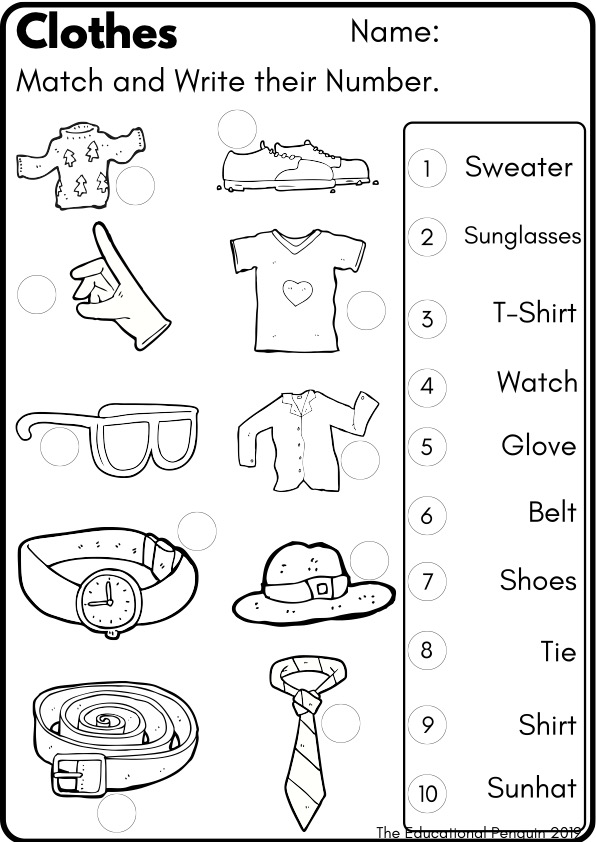
- Optional: clothes vocabulary matching and tracing pages, weather-and-clothes sorting pages, and clothes sentence pyramid worksheets
Word lists
- One thing (a / an)
- a hat, a cap, a coat, a jacket, a raincoat, a scarf, a dress, a skirt, a shirt, a T-shirt, a sweater, an umbrella
- Always plural or in pairs
- pants, shorts, jeans, sunglasses, shoes, socks, boots, rain boots, sandals, gloves, mittens
- Verbs
- wear, put on, take off, zip up, button, tie, hang up
- Sentence pyramid
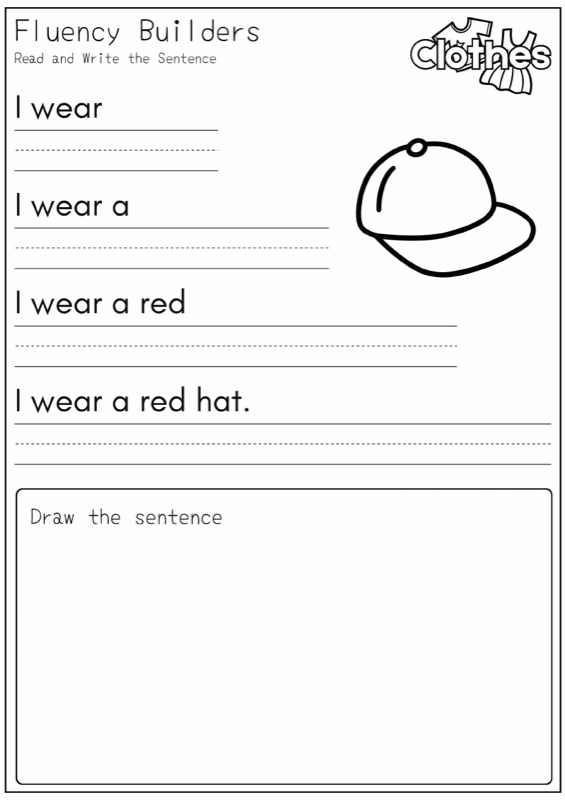
- I put / I put on / I put on my boots / I put on my rain boots. // She wears / She wears a / She wears a long scarf. // We take off / We take off our wet socks.
- Weather riddles
- It is cold and white outside. I put on mittens and a hat. What is the weather? (snowy) / The sun is hot. I wear shorts and sandals. (sunny) / I need a raincoat and rain boots. (rainy)
The lesson, step by step
1. Warm-up: what am I wearing? (5 min)
Stand in front of the class and point to your own clothes: “I am wearing a blue shirt. I am wearing black shoes.” Then ask children about theirs: “Mei, what are you wearing?” Accept a single word (“Shoes!”) and give back the full sentence: “Yes, you are wearing red shoes.”
2. The dress-up bag (8 min)
Pull the clothes out of the bag one at a time. Say each word, and the class repeats it with a gesture: patting the head for hat, wiggling fingers for gloves. Put each item on as you name it: “I put on the hat. I put on the scarf.” By the end you are wearing everything at once.
Now take things off one by one, saying “I take off the scarf.” Invite children to give the instruction: “Take off the sunglasses!” Listen for the difference between put on and take off.
3. One or a pair? (7 min)
Draw two columns on the board: “one thing” and “always more than one”. Hold up a picture card and ask the class where it goes. A hat goes in the first column. Shoes go in the second, because we wear two of them. Pants and shorts go there too, even though they are one piece of clothing. English counts them by the two legs.
Read the lists back with the articles: “a hat, a coat… shoes, pants.” Say “a pants” yourself and ask the class if it sounds right. Then try sentences: “My socks ___ wet.” Children write is or are on their whiteboards.
4. What will we wear today? (9 min)
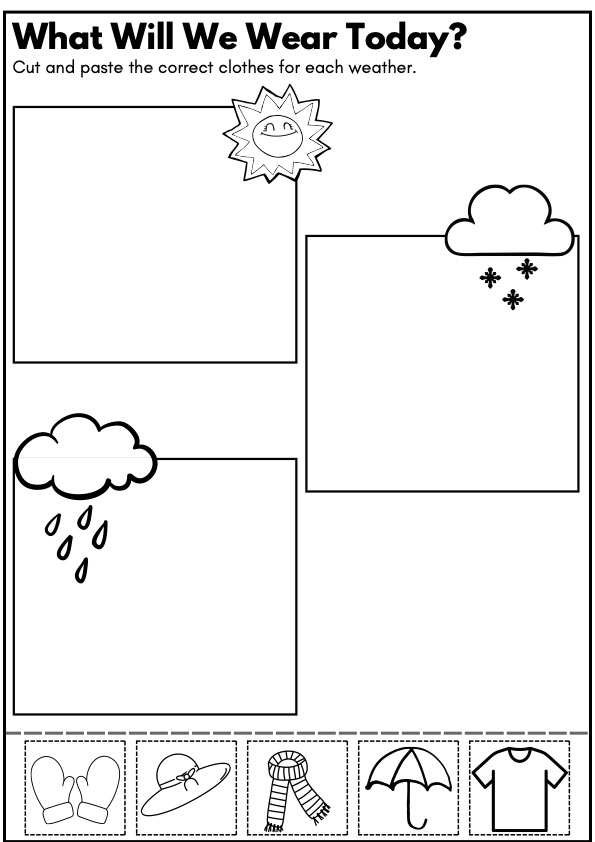
Put the four weather pictures on the board. Hold up a clothes card and ask, “When do we wear this?” Children come up and stick it under a weather picture. Some items fit more than one: a jacket works for windy and rainy days. Let children explain their choice in a sentence: “I wear a jacket when it is windy.”
Then read the weather riddles. Children write or draw the weather on their whiteboards and hold them up. Ask one or two children to make up a riddle of their own for the class.
5. Build a sentence (7 min)
Write the first sentence pyramid on the board one line at a time, and read each line with the class: “I put”, then “I put on”, then “I put on my boots”, then the full sentence. Children copy the last line on their whiteboards and draw it. Do the second pyramid together, then let children make their own with a clothes word and a color, such as “He wears a green cap.”
Listen for “He wear” and “She put on” in the present. Point to the s in wears on the board.
6. Exit task: pack for the weather (4 min)
Show one weather picture. Children write a sentence about what they would wear and draw it: “It is snowy. I put on my coat and mittens.” Check the article and the plural on each item.
Support and challenge
- For newer learners, focus on 8 to 10 items and on “I wear ___” only. Add put on, take off and the plural column in a later lesson.
- Stronger speakers can describe a classmate without saying their name, using colors and patterns (“This person is wearing a striped shirt and blue jeans”), while the class guesses who it is.
- Children who find writing slow can label a drawing of themselves dressed for the weather, with arrows from each word to the item.
Tips for ESL and EFL classes
- Japanese uses different verbs depending on where clothing goes: kaburu for a hat, kiru for a shirt or coat, haku for pants, socks and shoes. Korean splits the verbs in a similar way. English uses wear for all of them, which helps, but children may need help knowing that wear does not mean the same as put on.
- Mandarin has two main verbs, chuān for clothes and shoes and dài for hats, gloves and glasses. Children may try to find a second English verb for hats. Reassure them that wear works for everything.
- Japanese and Korean speakers often don’t mark plurals, so “shoe” for a pair is common. Keep the plural column on the wall and model “a pair of shoes” for children who are ready for it.
How to check learning
- Can the child name at least 12 clothes items from pictures or real clothes?
- Do they use a with single items and no a with pants, shoes and socks?
- Can they choose clothes for a weather picture and say a sentence with wear or put on?
What to teach next
Make the weather and clothes talk part of each morning. A helper looks out the window, reports the weather and says what the class should wear outside at recess. Later, add the past tense with the same clothes (“Yesterday I wore my rain boots”), and use the topic for a class book where each child draws themselves dressed for a favorite season.
Printables for this lesson
Optional. These Ribbit Pond worksheets match the lesson if you’d rather not make your own.