Vowel Teams Lesson Plan: Two Letters, One Long Vowel Sound
- 1st Grade
- Phonics: long vowel teams (ai, ay, ee, ea, oa, ow)
- 40 minutes
A vowel team is two letters that work together to spell one vowel sound. In “rain”, the a and the i don’t each make a sound; together they spell long a. Children who have just learned magic e now meet a second way to spell the same long vowels, and reading a word like “boat” means treating oa as one unit instead of sounding out o, then a.
You may know the rhyme “when two vowels go walking, the first one does the talking”. It works for the six teams in this lesson but fails for many words children will meet soon (bread, said, out), so this plan teaches each team as a spelling to learn, with a simple position clue where one exists. Children should already read CVC and magic e words with confidence and know the difference between a vowel’s name and its short sound.
Objectives
- Recognize ai, ay, ee, ea, oa and ow as teams that spell one long vowel sound.
- Blend one-syllable vowel team words, keeping the team together as a single sound.
- Use position to choose between ai and ay, and between oa and ow, when spelling.
- Read short sentences and a short story containing vowel team words.
What you need
- Letter cards or magnetic letters, plus one card for each team with both letters on it (ai, ay, ee, ea, oa, ow)
- Word cards for the lists below
- A sorting chart with three columns: long a, long e, long o
- Mini whiteboards and markers
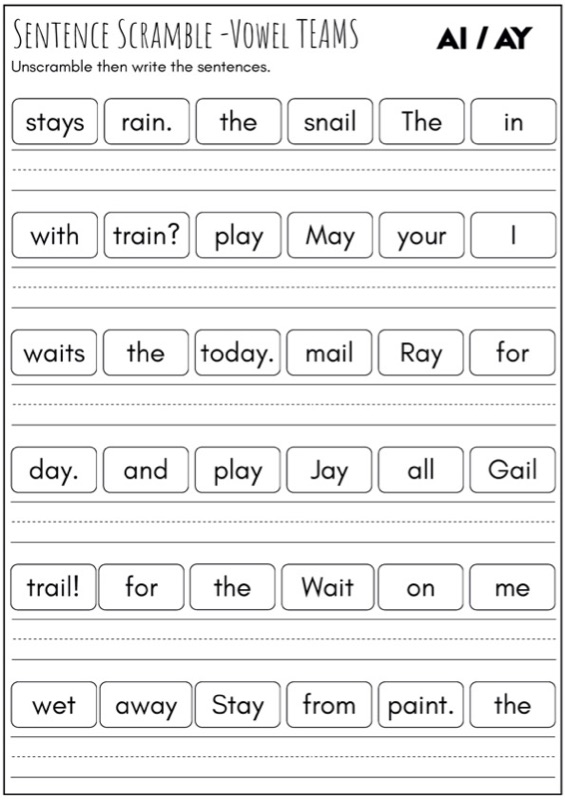
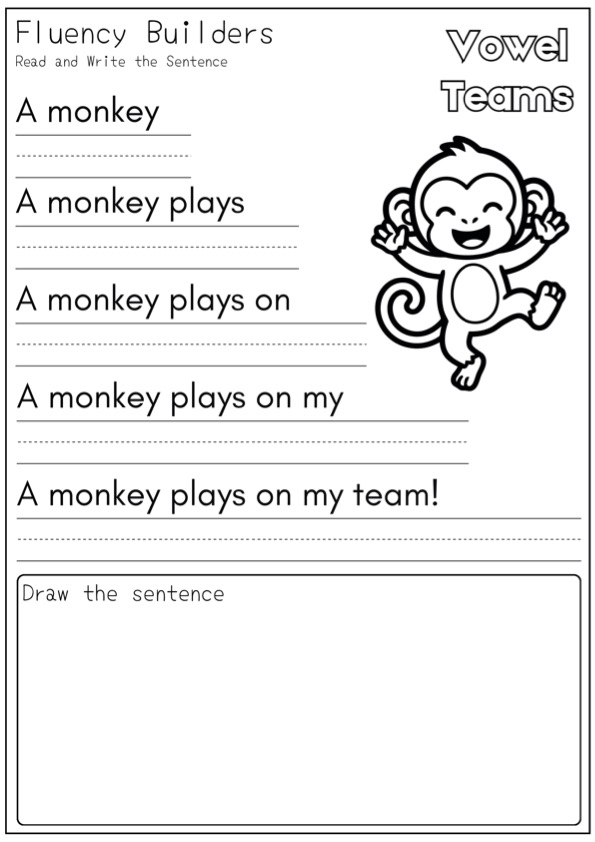
- Optional: a vowel teams workbook, vowel team sentence scrambles or sentence pyramid pages
Word lists
- ai (middle)
- rain, tail, wait, paint, snail, train
- ay (end)
- day, play, say, tray, stay, gray
- ee
- see, tree, feet, green, sleep, sheep
- ea
- eat, sea, read, leaf, team, dream
- oa (middle)
- boat, coat, road, soap, goat, toad
- ow (end, long o)
- snow, grow, slow, low, show, row
- Sentences
- The train waits for the rain to stop. / Three green sheep eat by the sea. / Jay can paint a boat today. / The goat and the toad sleep in the snow.
- Short story: Gail and the Goat
- Gail has a gray goat. The goat likes to eat. One day, it ate Gail’s green coat! Gail filled a pail with oats. The goat ate the oats and let go of the coat. Now the coat has a hole in it, but Gail is glad to have it back.
The lesson, step by step
1. Warm-up: long or short? (4 min)
Say a word and have children show a thumbs up if they hear long a and a thumbs down if they hear short a: cake, cat, rain, ran, day, map. Remind them that they already know one way to spell long a, with magic e in “cake”. Tell them that today they will learn another way, with two vowels side by side.
2. Introduce the teams (9 min)
Write “rain” and underline ai. Say: “These two letters are a team. They spell one sound together, long a.” Draw three boxes under the word and put r, ai and n in them. Four letters, three sounds. The ai going into one box is the picture you want children to remember.
Write “play” and underline ay. Explain that English words almost never end in i, so at the end of a word long a is usually spelled ay. Then write “boat” and “snow”: oa usually comes in the middle of a word and ow at the end. Last, write “feet” and “team”. Both ee and ea spell long e and can turn up anywhere, so children learn which words use which as they read.
Read each word list together once, sweeping a finger under the team as you say its sound.
3. Sound boxes (8 min)
Children draw four boxes on their whiteboards. Say a word, have them say its sounds, then write one sound per box, with the whole team in one box. Use tail, feet, boat, sea, snow and train (train needs all four boxes: t, r, ai, n).
Listen and look for children who split the team across two boxes. Have them say the word slowly with you and count the sounds on their fingers before they write.
4. Sort by sound (8 min)
Give pairs a mixed pile of word cards. They read each card aloud and place it in the long a, long e or long o column. When the piles are done, ask: “What spellings do you see in the long a column?” Children will notice ai and ay. Ask where each one sits in the word. Do the same for the other two columns.
5. Read in context (7 min)
Display the four sentences. Read each one to the class first, then read it together, then have pairs read it to each other. Children underline every vowel team they can find.
Then read the Gail and the Goat story the same way. Ask: “What did the goat eat first? How did Gail get her coat back?” A quick question keeps the focus on meaning as well as sounds.
6. Wrap-up (4 min)
Dictate three words: day, green and coat. Children write them on their whiteboards and hold them up. Check which team each child chose. If a child writes “dai” or “cowt”, point back to the position clues on the board.
Support and challenge
- If six teams is too many at once, teach ai, ay and ee in this lesson and add ea, oa and ow over the next two days.
- Confident readers can add the long i teams ie and igh (pie, night) as a fourth column and write a sentence using one word from each column.
- For children who find spelling hard, give them the six team cards to choose from instead of asking them to write the team from memory.
Tips for ESL and EFL classes
- In Japanese, two vowels side by side are usually both pronounced (“ai” is two sounds, a-i), so children may read “rain” as “ra-in”. Keep using one card and one box for each team so they see it as a single sound.
- Long a and long o in English glide slightly, toward an i sound in “rain” and a u sound in “boat”. Model the mouth movement slowly and let children feel their lips round at the end of “go”.
How to check learning
- Does the child blend the team as one sound (rain, not ra-in)?
- Can they read a mixed list of 12 vowel team words with no more than two errors?
- When spelling day, boat and snow, do they choose ay, oa and ow?
What to teach next
Spend the next lessons on ie and igh, then ue, ui, oo and ew. After that, move to the diphthongs oi/oy, ou/ow and au/aw, and show children that ow has two jobs: long o in “snow” and the sound in “cow”. Later in the week, use sentence scrambles so children read vowel team words while building sentences themselves.
Printables for this lesson
Optional. These Ribbit Pond worksheets match the lesson if you’d rather not make your own.