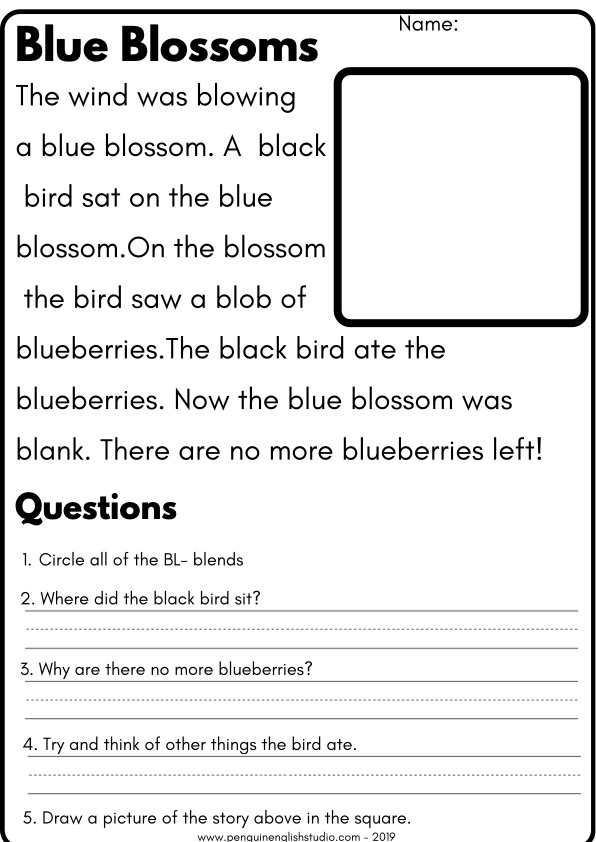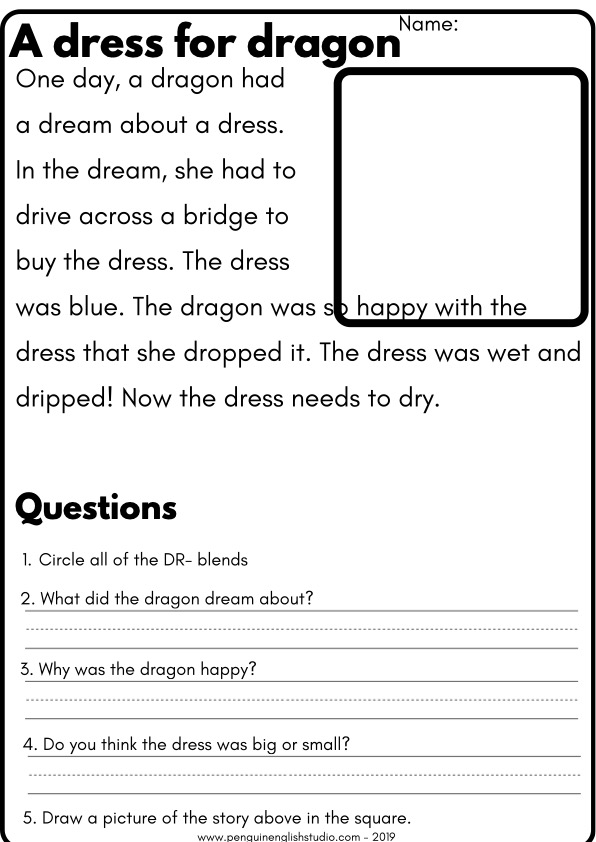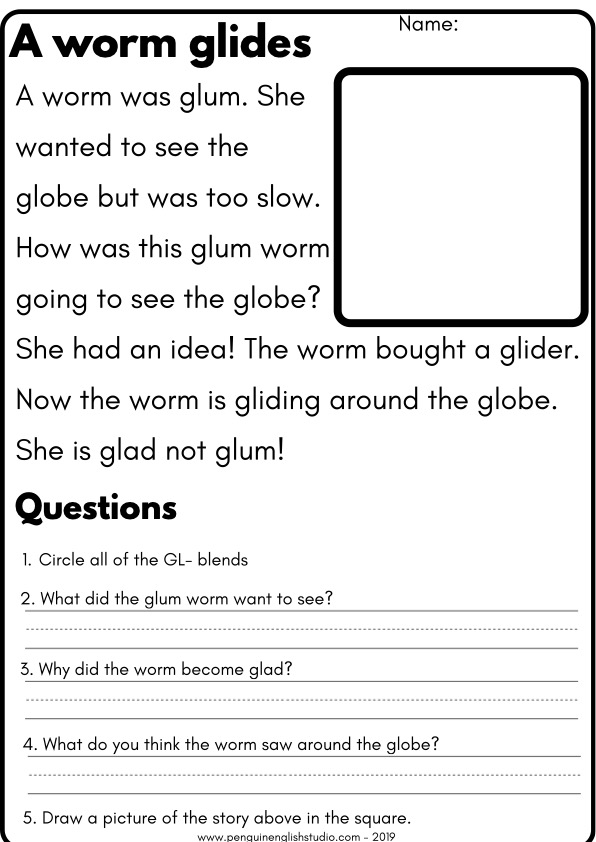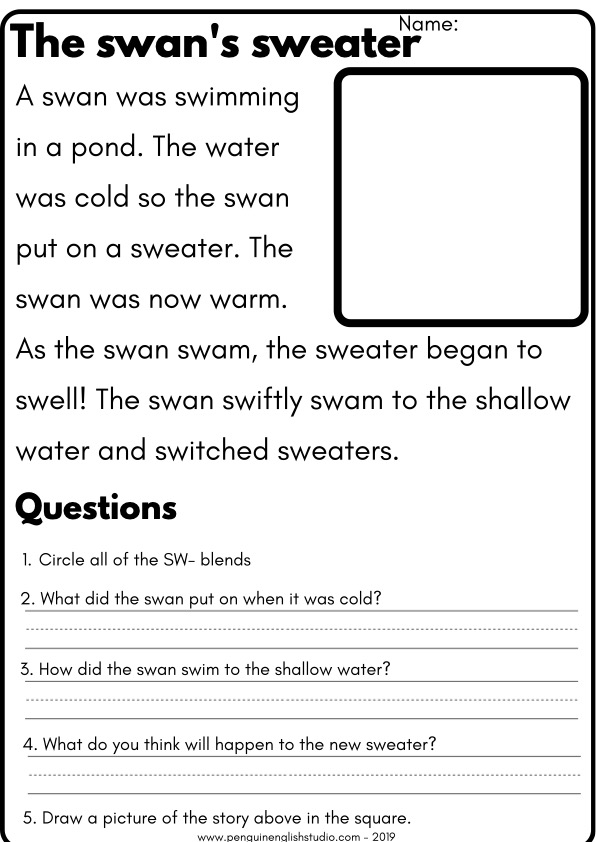
Consonant Blends Reading Lesson Plan: Short Stories With BL, BR, CL and CR
- 1st Grade
- Reading: consonant blends in text
- 35 minutes
Once children can read blend words in a list, they need to read them in sentences, where the meaning helps them check their decoding. This lesson uses a short story packed with words that start with bl, br, cl and cr. It works best after children have been taught the blends themselves (see the consonant blends lesson plan).
You can use the example story below or a printed blends passage.
Objectives
- Read a short story containing initial blends with accuracy.
- Find and sort the blend words in the text.
- Answer questions about the story and respond with a drawing.
What you need
- A short blends story for each child
- Colored pencils
- Optional: printed blends reading passages with questions
Word lists
- Example story
- Brad is a crab. He has a black shell and big claws. Brad can clap his claws. Clap, clap, clap! A blue fish swims by. The fish blinks at Brad. Brad is not cross. He claps for the fish.
- Blend words in the story
- Brad, crab, black, claws, clap, clap, blue, blinks, cross, claps
The lesson, step by step
1. Warm-up: blend flash (4 min)
Write bl, br, cl and cr on the board. Point to each blend and have children say it, then give a word that starts with it. Then read five words from the story quickly: crab, black, clap, blue, cross.
2. Set a purpose (3 min)
Tell children the story is about a crab named Brad. Ask: “What can a crab do?” Then give them a question to keep in mind while reading: “What does Brad do when the fish swims by?”
3. First read (7 min)
Children read the story quietly, pointing to each word. Listen in to individuals. If a child reads “cab” for “crab”, ask: “Does that make sense? A cab with claws?” Meaning is a useful check on blend errors, because dropping a sound usually changes the word into something else.
4. Blend hunt (7 min)
Children circle every blend word in the story, then sort them into a four-column table: bl, br, cl, cr. Compare answers as a group. Point out that “claws”, “clap” and “claps” all start with cl, and that “Brad” starts with a blend even though it’s a name.
5. Partner reading (6 min)
Pairs read the story aloud, taking turns sentence by sentence. On the second read, the listener says “Clap, clap, clap!” with the reader, with real claps.
6. Questions and drawing (8 min)
Ask the purpose question and two others: “What color is Brad’s shell?” “Is Brad angry with the fish? How do you know?” (“Brad is not cross” is the clue, and “cross” may be a new word, so check it.)
Children finish by drawing Brad and the fish and writing one sentence under the picture, using at least one blend word.
Support and challenge
- For less confident readers, read the story to them first while they follow with a finger, then have them read it back.
- For confident readers, have them write two more sentences to continue the story, using new blend words from the board.
Tips for ESL and EFL classes
- Watch for added vowels in blends (“kurab” for “crab”) and model the blend on its own before rereading the word.
- Words like “cross” (angry) and “blinks” may be unfamiliar. Act them out before reading.
How to check learning
- Does the child read the blend words with both consonants?
- Can they find at least eight of the ten blend words?
- Can they explain how Brad feels using evidence from the story?
What to teach next
Repeat the routine with stories for dr, fr, fl and tr, then the s blends. Keep the stories in a reading folder for fluency practice.
Printables for this lesson
Optional. These Ribbit Pond worksheets match the lesson if you’d rather not make your own.