Magic E Lesson Plan: Teaching CVCe Words From Cap to Cape
- 1st Grade
- Phonics: magic e / silent e (CVCe)
- 40 minutes
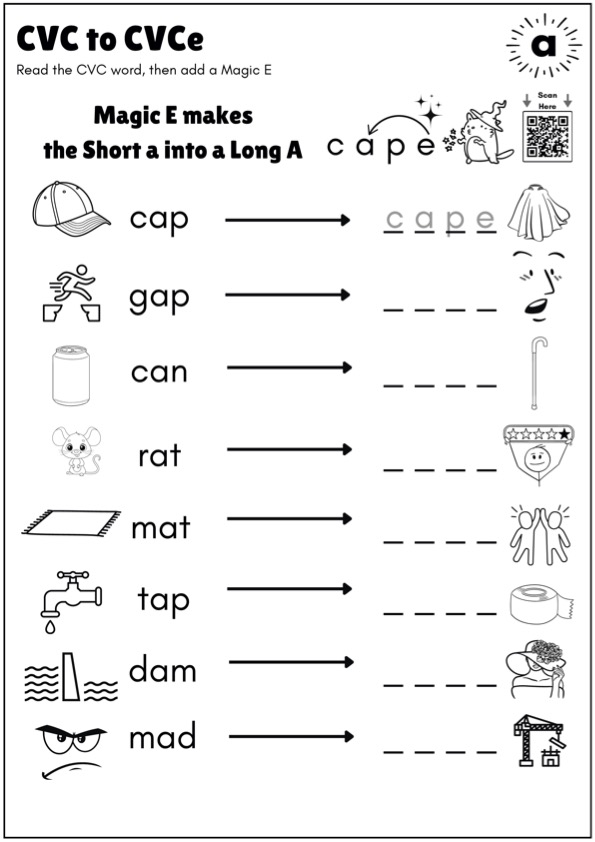
Magic e (also called silent e, bossy e or the split vowel digraph) is often the first time children learn that a letter can change a word without making a sound of its own. Add an e to “cap” and the a says its name: “cape”. This lesson starts from CVC words children already know and turns them into CVCe words, so the new pattern is anchored to something familiar.
Children should be confident with short vowel CVC words and know the letter names for a, i, o and u.
Objectives
- Explain that an e at the end of a CVC word makes the vowel say its name.
- Read CVCe words with a_e, i_e, o_e and u_e.
- Tell CVC and CVCe words apart in a mixed list and read each correctly.
What you need
- A “magic wand” (a pencil with a star on it works) and a large e card
- Word cards for the CVC / CVCe pairs below
- Two sorting mats or areas labeled “short vowel” and “magic e”
- Optional: magic e worksheets and flash cards
Word lists
- a_e
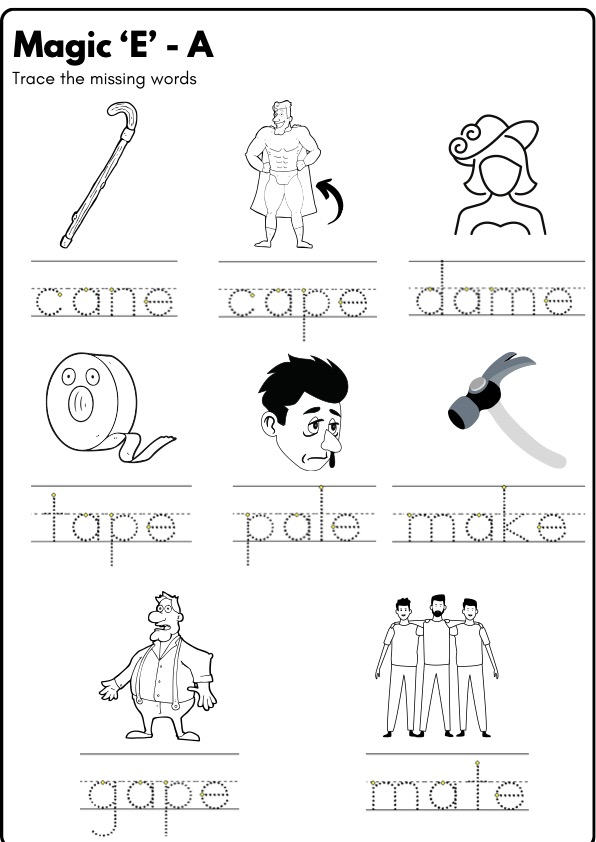
- cap / cape, tap / tape, can / cane, mad / made, hat / hate
- i_e
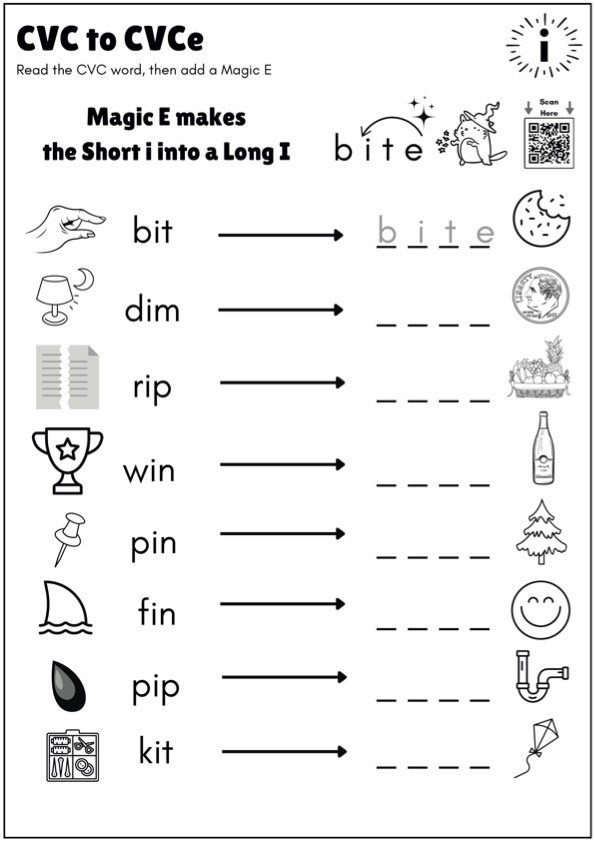
- kit / kite, pin / pine, bit / bite, rid / ride, dim / dime
- o_e
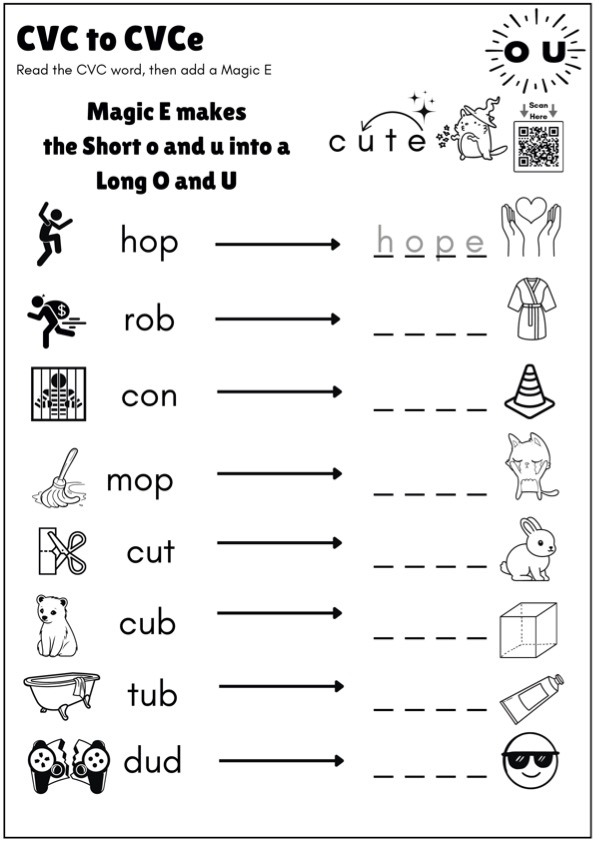
- hop / hope, not / note, rob / robe, cod / code
- u_e
- cub / cube, tub / tube, cut / cute, us / use
The lesson, step by step
1. Warm-up: vowel names and sounds (5 min)
Hold up the vowel cards one at a time. Children say the sound first, then the name: “a says /a/, its name is A.” Do all five. The whole lesson depends on children knowing the difference between a vowel’s sound and its name, so make sure this is solid.
2. The magic e trick (8 min)
Write “cap” on the board and read it together. Wave the wand, add an e to the end, and say: “Magic e jumps over the p and taps the a. Now a says its name. Cape!” Draw an arc from the e back to the a.
Do the same with tap → tape, kit → kite, hop → hope and cub → cube. After the first two, let children predict the new word before you say it.
- Ask: “Does the e make a sound?” (No, it’s silent.)
- Ask: “What does it do?” (It makes the vowel say its name.)
3. Partner wand game (8 min)
Give each pair a set of CVC word cards and one e card. One child reads the CVC word. The partner places the e at the end and reads the new word. Then they swap. Walk around and listen for children who read “kite” as “kit-ee”: remind them the e is silent.
4. Short or magic? Sort (8 min)
Mix CVC and CVCe word cards together. Children take a card, read it, and put it on the right mat. Before reading, ask them to look at the end of the word first: “Is there an e? Then the vowel says its name.” Teaching them to check the end of the word before reading the middle is the habit that makes CVCe reading reliable.
5. Read and draw (7 min)
Write two sentences, each with a CVC and a CVCe word that look alike: “The cub sat on a cube.” “Kate has a hat and a cape.” Children read them and draw one, labeling the magic e word in their picture.
6. Wrap-up (4 min)
Say a CVCe word aloud (“bike”, “home”, “cute”). Children tell you the vowel they hear, then spell it in the air with their wand finger, ending with a flick for the magic e.
Support and challenge
- Teach only a_e in the first lesson if children are unsure, and add i_e, o_e and u_e on later days.
- Confident readers can find CVCe words that don’t have a CVC partner (lake, bone, smile) and write a sentence with two of them.
Tips for ESL and EFL classes
- In many languages, including Japanese, written vowels always say the same thing. The idea that a silent letter changes another vowel is new. Use the same gesture or wand action every time so the rule feels like a routine.
- Some children will pronounce the final e (“kai-to”). Cover the e with a finger, read the word, then uncover it and say “still silent!”
How to check learning
- Can the child explain the magic e rule in their own words?
- Can they read a mixed list of ten CVC and CVCe words with no more than two errors?
- In the sort, do they look at the end of the word before reading it?
What to teach next
Next lesson, practice CVCe words in sentences and short stories. Later, introduce e_e (Pete, these) and words where the e doesn’t change the vowel (have, give), as exceptions.
Printables for this lesson
Optional. These Ribbit Pond worksheets match the lesson if you’d rather not make your own.